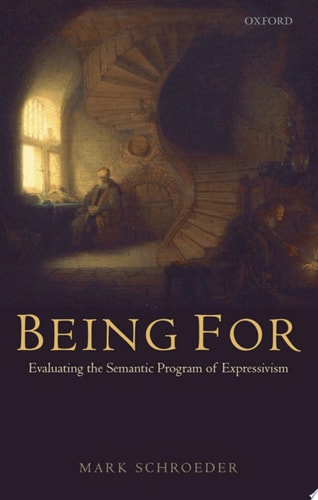
Being For: Evaluating the Semantic Program of Expressivism
0
0
As an Amazon Associate and affiliate partner, Menrva Books earns from qualifying purchases. Learn more
Author Description
Expressivism - the sophisticated contemporary incarnation of the noncognitivist research program of Ayer, Stevenson, and Hare - is no longer the province of metaethicists alone. Its comprehensive view about the nature of both normative language and normative thought has also recently been applied to many topics elsewhere in philosophy - including logic, probability, mental and linguistic content, knowledge, epistemic modals, belief, the a priori, and even quantifiers.Yet the semantic commitments of expressivism are still poorly understood and have not been very far developed. As argued within, expressivists have not yet even managed to solve the "negation problem" - to explain why atomic normative sentences are inconsistent with their negations. As a result, it is far from clear that expressivism even could be true, let alone whether it is.Being For seeks to evaluate the semantic commitments of expressivism, by showing how an expressivist semantics would work, what it can do, and what kind of assumptions would be required, in order for it to do it. Building on a highly general understanding of the basic ideas of expressivism, it argues that expressivists can solve the negation problem - but only in one kind of way. It shows how this insight paves the way for an explanatorily powerful, constructive expressivist semantics, which solves many of what have been taken to be the deepest problems for expressivism. But it also argues that no account with these advantages can be generalized to deal with constructions like tense, modals, or binary quantifiers. Expressivism, the book argues, is coherent and interesting, but false.
Menrva's Summary
THE THESIS
This book investigates whether the semantic program of expressivism can provide a coherent and comprehensive account of normative language and thought. Mark Schroeder, a prominent philosopher, utilizes formal semantic analysis to evaluate the internal consistency of expressivist theories. He argues that while expressivists can resolve specific challenges like the negation problem, the resulting framework fails to generalize to broader linguistic constructions, ultimately concluding that the program is untenable.
THE SCOPE MAP
What You Will Find
- A formal evaluation of the semantic commitments inherent in contemporary expressivism.
- A proposed solution to the negation problem within an expressivist framework.
- Analysis of the limitations of expressivist semantics regarding tense, modals, and binary quantifiers.
- A critical assessment of the application of expressivism to logic, probability, and epistemic content.
THE AUTHORITY PERSPECTIVE
Experts recognize this work as a rigorous and essential contribution to the metaethical debate surrounding noncognitivism. Readers frequently note the technical density of the prose, which requires a strong background in formal semantics and philosophy of language to fully appreciate the author's arguments.
Page Count:
214
Publication Date:
2008-08-15
Publisher:
Oxford University Press
ISBN-10:
0199534659
ISBN-13:
9780199534654
Philosophy
Logic
Semantics
Ethics
Metaethics
Language
Community Tags
Similar Books