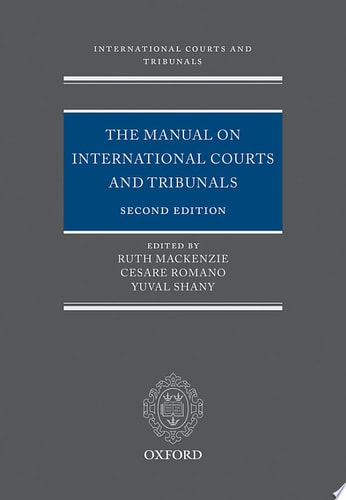
The Manual on International Courts and Tribunals
0
0
As an Amazon Associate and affiliate partner, Menrva Books earns from qualifying purchases. Learn more
Author Description
The dramatic rise in the number of international courts and tribunals and the expansion of their legal powers has been one of the most significant developments in international law of the late 20th century. The emergence of an international judiciary provided international law with a stronger than ever law enforcement apparatus, and facilitated the transformation of many aspects of international relations from being power-based to being law-based.The first edition of the Manual on International Courts and Tribunals, published in 1999, was the first book to survey systematically this new institutional landscape, by describing in an accessible and uniformly structured manner the legal powers and operating procedures of all major international judicial and quasi-judicial bodies. In doing so, it laid the groundwork for comparative study and research of the law and practice of international courts and tribunals - an emerging field of international legal research, which has already spurred a series of publications, conferences and academic courses.This second edition updates the first edition by describing the many legal changes that have taken place in the last decade, including important reforms in the laws and procedures of many international courts and tribunals, relevant developments in their increasingly rich jurisprudence and the creation of new judicial fora. Moreover, it assesses the overall record of these judicial bodies. The data and legal analysis offered in the book provide both practitioners and academics with an important basis of knowledge that will help them better understand the details of international adjudication and its context.
Menrva's Summary
THE THESIS
This volume investigates the structural evolution and operational efficacy of international judicial bodies within the framework of global law enforcement. The authors, a team of distinguished legal scholars and practitioners including Philippe Sands and Cesare Romano, synthesize complex institutional data to evaluate how international courts have shifted global relations from power-based dynamics to law-based systems. By providing a comparative analysis of diverse judicial and quasi-judicial entities, the text establishes a foundational framework for understanding the mechanisms of international adjudication.
THE SCOPE MAP
What You Will Find
- Comprehensive surveys of legal powers and operating procedures for major international courts and tribunals.
- Comparative analysis of institutional reforms and procedural changes occurring over the last decade.
- Detailed assessments of jurisprudence and the record of judicial bodies in international relations.
- Methodological approaches for researching and understanding the landscape of international adjudication.
THE AUTHORITY PERSPECTIVE
Legal scholars and practitioners frequently cite this work as a foundational reference for the study of international judicial institutions. The text is noted for its systematic structure and its utility in navigating the increasingly complex landscape of international legal fora.
Page Count:
500
Publication Date:
2010-05-20
Publisher:
Oxford University Press
ISBN-10:
0199545278
ISBN-13:
9780199545278
Politics
Academic
Reference
Law
International Law
Community Tags
Similar Books