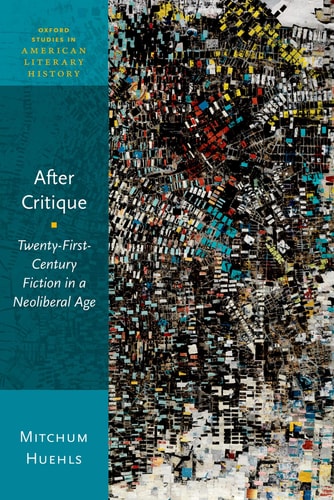
After Critique: Twenty-First-Century Fiction in a Neoliberal Age
0
0
As an Amazon Associate and affiliate partner, Menrva Books earns from qualifying purchases. Learn more
Author Description
Periodizing contemporary fiction against the backdrop of neoliberalism, After Critique identifies a notable turn away from progressive politics among a cadre of key twenty-first-century authors. Through authoritative readings of foundational texts from writers such as Percival Everett, Helena Viramontes, Uzodinma Iweala, Colson Whitehead, Tom McCarthy, and David Foster Wallace, Huehls charts a distinct move away from standard forms of political critique grounded in rights discourse, ideological demystification, and the identification of injustice and inequality.The authors discussed in After Critique register the decline of a conventional leftist politics, and in many ways even capitulate to its demise. As Huehls explains, however, such capitulation should actually be understood as contemporary U.S. fiction's concerted attempt to reconfigure the nature of politics from within the neoliberal beast. While it's easy to dismiss this as post-ideological fantasy, Huehls draws on an array of diverse scholarship--most notably the work of Bruno Latour--to suggest that an entirely new form of politics is emerging, both because of and in response to neoliberalism. Arguing that we must stop thinking of neoliberalism as a set of norms, ideological beliefs, or market principles that can be countered with a more just set of norms, beliefs, and principles, Huehls instead insists that we must start to appreciate neoliberalism as a post-normative ontological phenomenon. That is, it's not something that requires us to think or act a certain way; it's something that requires us to be in and occupy space in a certain way. This provocative treatment of neoliberalism in turn allows After Critique to reimagine our understanding of contemporary fiction and the political possibilities it envisions.
Menrva's Summary
THE THESIS
This book investigates how twenty-first-century American fiction has shifted its political engagement in response to the pervasive influence of neoliberalism. Mitchum Huehls, an established scholar in American literary history, utilizes a framework grounded in ontological theory and the work of Bruno Latour to analyze contemporary literature. He argues that rather than engaging in traditional ideological critique, these authors are reconfiguring the nature of political existence within a post-normative neoliberal landscape.
THE SCOPE MAP
What You Will Find
- Analysis of works by Percival Everett, Helena Viramontes, Uzodinma Iweala, Colson Whitehead, Tom McCarthy, and David Foster Wallace.
- A theoretical framework that redefines neoliberalism as an ontological phenomenon rather than a set of market norms.
- Application of Bruno Latour’s scholarship to literary interpretation.
Scope Limits
- The text focuses primarily on U.S. fiction and does not provide a global survey of neoliberal literature.
- It does not offer a traditional political manifesto or a guide to countering neoliberalism through conventional activism.
THE AUTHORITY PERSPECTIVE
Scholars and critics recognize this work as a significant contribution to the field of contemporary American literary studies. Readers frequently note the high level of theoretical density, making it a text best suited for advanced students and academics interested in the intersection of politics and literature.
Page Count:
240
Publication Date:
2019-09-01
Publisher:
Oxford University Press
ISBN-10:
0190067837
ISBN-13:
9780190067830
Politics
English & College Success
English
Neoliberalism
New Used & Rental Textbooks
American
Literary Criticism
Politics & Government
Criticism history
Academic
Community Tags
Other Editions(2)
Similar Books



Reader Comments
Share Your Thoughts
No comments yet. Be the first to share your thoughts!