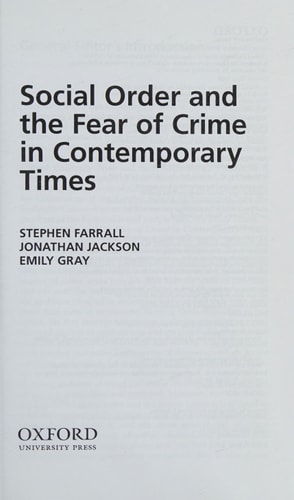
Social Order and the Fear of Crime in Contemporary Times
0
0
As an Amazon Associate and affiliate partner, Menrva Books earns from qualifying purchases. Learn more
Author Description
The fear of crime has been recognized as an important social problem in its own right, with a significant number of citizens in many countries concerned about crime. In this book, the authors critically review the main findings from over 35 years of research into attitudes to crime, highlighting groups who are most fearful of crime and exploring the theories used to account for that fear. Using this research, the authors move on to propose a new model for the fear of crime, arguing that such methods, which involve intensity questions (such as 'how worried are you about x...'), may actually conflate an 'expressive' or 'attitudinal' component of the fear of crime with an experiential component and therefore fail to provide a comprehensive insight into how crime is perceived.Taking an entirely new approach to their subject, the authors use existing quantitative data from the British Crime Survey to pose theoretically informed questions to help identify those who only 'expressively' fear crime, separating them from those who have the actual experience of worrying about crime. By exploring the extent to which each group has different social attitudes and backgrounds, and whether there is more than one social/cultural form of the fear of crime, this innovative and exciting title promises to reposition this aspect of criminology to a more prominent place.
Menrva's Summary
THE THESIS
This book investigates the conceptual limitations of traditional fear-of-crime research by questioning whether standard survey methodologies accurately distinguish between expressive attitudes and genuine experiential worry. The authors, Emily Gray, Jonathan Jackson, and Stephen D. Farrall, draw upon over 35 years of criminological data to challenge the prevailing reliance on intensity-based survey questions. By re-evaluating existing quantitative data from the British Crime Survey, they propose a new theoretical model that separates symbolic social anxiety from actual personal concern, aiming to provide a more nuanced understanding of how crime is perceived in contemporary society.
THE SCOPE MAP
What You Will Find
- A critical review of 35 years of longitudinal research into public attitudes toward crime.
- A methodological critique of standard survey instruments that conflate expressive and experiential fear.
- Quantitative analysis utilizing data from the British Crime Survey to segment populations based on their fear profiles.
- A proposed theoretical framework for identifying distinct social and cultural forms of crime-related anxiety.
THE AUTHORITY PERSPECTIVE
Experts in the field of criminology recognize this work as a significant methodological intervention that forces a re-examination of how social surveys measure public sentiment. Scholars frequently cite the text for its rigorous attempt to refine the conceptual boundaries of fear-of-crime research.
Page Count:
200
Publication Date:
2009-12-13
Publisher:
Oxford University Press
ISBN-10:
0199540810
ISBN-13:
9780199540815
Psychology
Social Science
Criminology
Research Methods
Sociology
Fear Of Crime
Community Tags
Similar Books