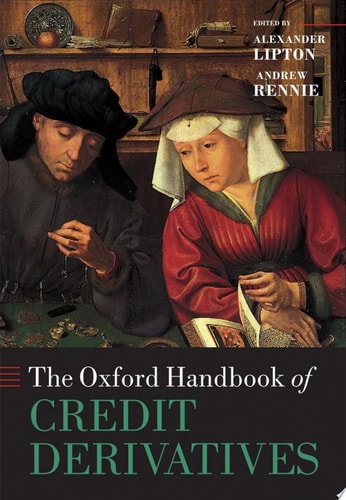
The Oxford Handbook of Credit Derivatives
0
0
As an Amazon Associate and affiliate partner, Menrva Books earns from qualifying purchases. Learn more
Author Description
From the late nineties, the spectacular growth of a secondary market for credit through derivatives has been matched by the emergence of mathematical modeling analysing the credit risk embedded in these contracts. This book aims to provide a broad and deep overview of this modeling, covering statistical analysis and techniques, modeling of default of both single and multiple entities, counterparty risk, Gaussian and non-Gaussian modeling, and securitization. Both reduced-form and firm-value models for the default of single entities are considered in detail, with extensive discussion of both their theoretical underpinnings and practical usage in pricing and risk. For multiple entity modeling, the now notorious Gaussian copula is discussed with analysis of its shortcomings, as well as a wide range of alternative approaches including multivariate extensions to both firm-value and reduced form models, and continuous-time Markov chains. One important case of multiple entities modeling--counterparty risk in credit derivatives--is further explored in two dedicated chapters. Alternative non-Gaussian approaches to modelling are also discussed, including extreme-value theory and saddle-point approximations to deal with tail risk. Finally, the recent growth in securitization is covered, including house price modeling and pricing models for asset-backed CDOs.The current credit crisis has brought modeling of the previously arcane credit markets into the public arena. Lipton and Rennie with their excellent team of contributors, provide a timely discussion of the mathematical modeling that underpins both credit derivatives and securitization. Though technical in nature, the pros and cons of various approaches attempt to provide a balanced view of the role that mathematical modeling plays in the modern credit markets. This Handbook will appeal to students and researchers in statistics, economics, and finance, as well as practicioners, credit traders, and quantitative analysts.
Menrva's Summary
THE THESIS
This handbook investigates the mathematical modeling techniques and statistical frameworks that underpin the valuation and risk assessment of credit derivatives and securitized assets. Editors Alexander Lipton and Andrew Rennie, both established experts in quantitative finance, curate a collection of contributions that examine the theoretical foundations and practical applications of credit risk models. The text evaluates the efficacy of various approaches, ranging from single-entity default models to complex multivariate structures, while addressing the limitations exposed by market volatility.
THE SCOPE MAP
What You Will Find
- Comprehensive analysis of reduced-form and firm-value models for single-entity default.
- Technical evaluation of Gaussian and non-Gaussian modeling, including copula methods and their shortcomings.
- Methodologies for assessing counterparty risk and securitization, such as asset-backed CDO pricing.
- Advanced statistical techniques including extreme-value theory and continuous-time Markov chains.
THE AUTHORITY PERSPECTIVE
Experts and practitioners recognize this volume as a rigorous, high-level reference for quantitative analysts and researchers in finance. Readers frequently note the significant mathematical density of the prose, which requires a strong background in statistics and financial engineering to fully comprehend.
Page Count:
736
Publication Date:
2011-03-22
Publisher:
Oxford University Press
ISBN-10:
0199546789
ISBN-13:
9780199546787
Economics
Business
Mathematics
Reference
Finance
Statistics
Community Tags
Other Editions(2)

Similar Books






Reader Comments
Share Your Thoughts
No comments yet. Be the first to share your thoughts!