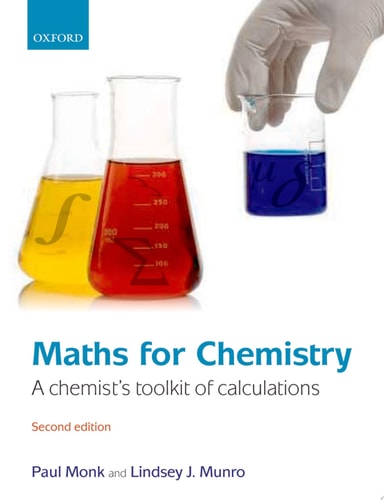
Maths for Chemistry: A Chemist's Toolkit of Calculations
0
0
As an Amazon Associate and affiliate partner, Menrva Books earns from qualifying purchases. Learn more
Author Description
Mathematical skills and concepts lie at the heart of chemistry; however, they are also often the aspects of the subject that students fear the most. Now in a new edition, Maths for Chemistry addresses the challenges faced by many students in acquiring the math skills necessary to gain a full understanding of chemistry. Working from basic yet essential principles, this unique text builds students' confidence by leading them through the subject in a steady, progressive way, moving from basic algebra all the way to quantum mathematics. Employing a modular structure, authors Paul Monk and Lindsey J. Munro present the material in short, manageable sections in order to keep the content as accessible as possible.Opening with an introduction to the "language" of math and the fundamental rules of algebra, Maths for Chemistry goes on to cover powers, indices, logs and exponential functions, graphical functions, and trigonometry before leading students through both differentiation and integration and on to quantum mathematics. It is the first book of its kind to use chemical examples throughout in order to demonstrate the relevance of mathematical concepts to the study of chemistry. The volume is enhanced by definitions of all key terms, self-check questions, and extensive end-of-chapter problems. A Companion Website features additional resources for both students and instructors.
Menrva's Summary
THE THESIS
This book investigates the fundamental mathematical competencies required for undergraduate chemistry students to master complex chemical concepts. Authors Paul Monk and Lindsey J. Munro leverage their academic expertise to bridge the gap between abstract mathematical theory and practical chemical application. The text utilizes a modular framework that systematically builds proficiency, ensuring that students can apply quantitative methods to chemical problems ranging from basic stoichiometry to advanced quantum mechanics.
THE SCOPE MAP
What You Will Find
- Comprehensive coverage of algebraic principles, logarithms, and exponential functions.
- Practical applications of trigonometry and graphical analysis within chemical contexts.
- Advanced modules on differentiation and integration as applied to physical chemistry.
- Pedagogical tools including self-check questions, key term definitions, and end-of-chapter problem sets.
THE AUTHORITY PERSPECTIVE
Educators and students frequently cite this volume as a foundational resource for bridging the gap between secondary school mathematics and university-level chemistry. The text is noted for its accessible, modular structure that allows for self-paced learning and targeted skill development.
Page Count:
560
Publication Date:
2010-06-25
Publisher:
Oxford University Press
ISBN-10:
0199541299
ISBN-13:
9780199541294
Science
textbook
Chemistry
Education
Mathematics
Community Tags
Similar Books