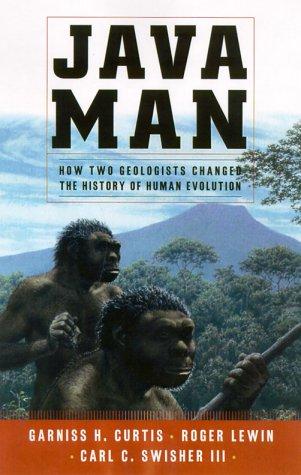
Java Man
0
0
As an Amazon Associate and affiliate partner, Menrva Books earns from qualifying purchases. Learn more
Author Description
The authors take us on a journey to the Indonesian island of Java, where Curtis and Swisher made two important discoveries: first, that human ancestors left the Cradle of Man-kind - the African continent - and migrated east almost two million years ago, much earlier than anthropologists had believed, and second, that Homo Erectus might have survived until as late as 27,000 years ago, suggesting that Homo Erectus actually coexisted with Homo sapiens and was probably not an evolutionary precursor. Their findings not only destroy the straight line of human evolution, but also call into question the inevitability of the evolution of Homo sapiens. Eventually, politics and a lack of funding find their way into the story, providing a realistic, if unfortunate, look at the travails that accompany scientific discovery. Swisher's and Curtis's findings are often met with skepticism, and their scientific methods are called into question. But conviction and determination lead them to conclusions that not only redefine their field but raise philosophical questions about what it means to be human.--BOOK JACKET.
Menrva's Summary
THE THESIS
The discovery of early human migration out of Africa and the potential survival of Homo Erectus challenges established timelines of human evolution. The authors, Swisher and Curtis, present findings from their work on the Indonesian island of Java, suggesting that human ancestors left Africa nearly two million years ago and that Homo Erectus may have coexisted with Homo sapiens. This challenges the linear model of human evolution and raises profound questions about the nature of humanity.
THE SCOPE MAP
- Evidence for early human migration out of Africa, predating current anthropological beliefs.
- Analysis of Homo Erectus survival, potentially coexisting with Homo sapiens.
- The impact of scientific skepticism and funding challenges on research.
- The philosophical implications of redefining human evolution and what it means to be human.
THE AUTHORITY PERSPECTIVE
The book details the scientific process, including the skepticism and funding issues that accompanied the discoveries made by Swisher and Curtis. The authors' findings are presented as challenging established theories of human evolution, suggesting a more complex and less linear progression. The narrative highlights the determination required to pursue scientific inquiry even when faced with doubt and resistance, ultimately leading to conclusions that redefine the field and prompt deeper reflection on human origins.
Page Count:
256
Publication Date:
2000-01-01
ISBN-10:
0684800004
ISBN-13:
9780684800004
Non-Fiction
Science
History
Scientific Discovery
Anthropology
Paleontology
Community Tags
Similar Books