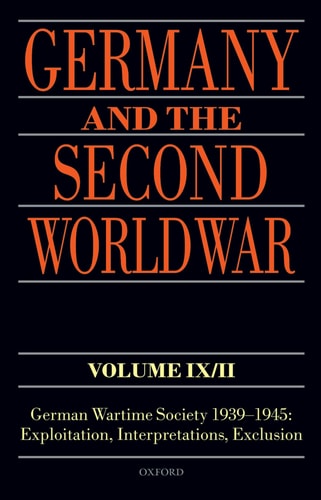
Germany and the Second World War Volume IX/II: German Wartime Society 1939-1945: Exploitation, Interpretations, Exclusion
0
0
As an Amazon Associate and affiliate partner, Menrva Books earns from qualifying purchases. Learn more
Author Description
The Second World War affected the lives and shaped the experience of millions of individuals in Germany - soldiers at the front, women, children, and the elderly sheltering in cellars, slave labourers toiling in factories, and concentration-camp prisoners and POWs clearing rubble in the Reich's devastated cities.Taking a 'history from below' approach, the volume examines how the minds and behaviour of individuals were moulded by the Party as the Reich took the road to Total War. The ever-increasing numbers of German workers conscripted into the Wehrmacht were replaced with forced foreign workers, slave labourers, and concentration camp prisoners. The interaction in everyday life between German civilian society and these coerced groups is explored, as is that society's relationship to the Holocaust.From early 1943, the war on the home front was increasingly dominated by attack from the air. The role of the Party, administration, police, and courts in providing for the vast numbers of those rendered homeless, in bolstering civilian morale with 'miracle revenge weapons' propaganda, and in maintaining order in a society in disintegration is reviewed in detail.For society in uniform, the war in the east was one of ideology and annihilation, with intensified indoctrination of the troops after Stalingrad. The social profile of this army is analysed through study of a typical infantry division. The volume concludes with an account of the various forms of resistance to Hitler's regime, in society and the military, culminating in the failed attempt on his life in July 1944.
Menrva's Summary
THE THESIS
This volume investigates how the German wartime society was structured, indoctrinated, and ultimately disintegrated under the pressures of Total War between 1939 and 1945. Jörg Echternkamp, a prominent historian at the Militärgeschichtliches Forschungsamt, utilizes a 'history from below' methodology to analyze the lived experiences of diverse groups within the Reich. The work synthesizes archival data, administrative records, and personal accounts to argue that the Nazi regime's ideological control and the exigencies of war fundamentally reshaped civilian behavior, labor dynamics, and social hierarchies.
THE SCOPE MAP
What You Will Find
- Analysis of the integration of forced foreign labor and concentration camp prisoners into the German civilian economy.
- Examination of the impact of Allied aerial bombardment on domestic morale and administrative stability.
- Case studies of the social profile and ideological indoctrination of the Wehrmacht infantry divisions.
- Detailed review of the mechanisms of state control, including the roles of the Party, police, and judicial systems in maintaining order.
- Documentation of various forms of internal resistance within both the military and civilian sectors.
THE AUTHORITY PERSPECTIVE
Experts recognize this volume as a definitive, scholarly contribution to the comprehensive 'Germany and the Second World War' series. Readers frequently note the academic density of the prose and the exhaustive nature of the research, making it a foundational text for historians specializing in the Third Reich.
Page Count:
1168
Publication Date:
2014-05-20
Publisher:
Oxford University Press
ISBN-10:
0199542961
ISBN-13:
9780199542963
History
Military History
German history
Social History
Community Tags
Similar Books