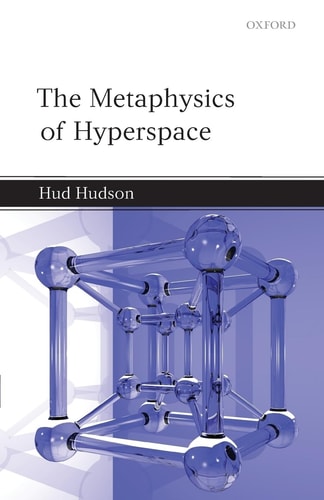
The Metaphysics of Hyperspace
0
0
As an Amazon Associate and affiliate partner, Menrva Books earns from qualifying purchases. Learn more
Author Description
Hud Hudson offers a fascinating examination of philosophical reasons to believe in hyperspace. He begins with some stage-setting discussions, offering his analysis of the term "material object," noting his adherence to substantivalism, confessing his sympathies regarding principles of composition and decomposition, identifying his views on material simples, material gunk, and the persistence of material objects, and preparing the reader for later discussions with introductory remarks on eternalism, modality and recombination, vagueness, bruteness, and the epistemic role of intuitions. The subsequent chapters are loosely organized around the theme of hyperspace. Hudson explores nontheistic reasons to believe in hyperspace in chapter 1 (e.g. reasons arising from reflection on incongruent counterparts and fine-tuning arguments), theistic reasons in chapter 7 (e.g. reasons arising from reflection on theistic puzzles known as the problem of the best and the problem of evil), and some distinctively Christian reasons in chapter 8 (e.g. reasons arising from reflection on traditional Christian themes such as heaven and hell, the Garden of Eden, angels and demons, and new testament miracles). In the intervening chapters, Hudson inquires into a variety of puzzles in the metaphysics of material objects that are either generated by the hypothesis of hyperspace, focusing on the topics of mirror determinism and mirror incompatibilism, or else informed by the hypothesis of hyperspace, with discussions of receptacles, boundaries, contact, occupation, and superluminal motion.Anyone engaged with contemporary metaphysics will find much to stimulate them here.
Menrva's Summary
THE THESIS
What philosophical arguments and metaphysical frameworks support the existence of hyperspace? Hud Hudson, a scholar in contemporary metaphysics, constructs a rigorous inquiry into the ontological status of hyperspace. By synthesizing analytical philosophy with theological and scientific considerations, he evaluates how the hypothesis of higher dimensions interacts with classical problems regarding material objects, persistence, and divine attributes. The text serves as a systematic exploration of how hyperspace functions as a potential solution to various logical and theological puzzles.
THE SCOPE MAP
What You Will Find
- Analysis of material object theory, including substantivalism, material gunk, and material simples.
- Exploration of nontheistic arguments for hyperspace, such as fine-tuning and incongruent counterparts.
- Examination of theistic and Christian theological implications, including the problem of evil and the nature of heaven and hell.
- Investigation into metaphysical puzzles like mirror determinism, superluminal motion, and the nature of spatial boundaries.
THE AUTHORITY PERSPECTIVE
Experts in the field recognize this work as a dense, specialized contribution to contemporary analytic metaphysics. Readers frequently note the high level of technical rigor required to engage with the author's arguments regarding material composition and spatial ontology.
Page Count:
236
Publication Date:
2008-09-15
Publisher:
Oxford University Press
ISBN-10:
0199549257
ISBN-13:
9780199549252
Science
Religion
Philosophy
Metaphysics
Theology
Fourth Dimension
Community Tags
Other Editions(3)

Similar Books












Reader Comments
Share Your Thoughts
No comments yet. Be the first to share your thoughts!