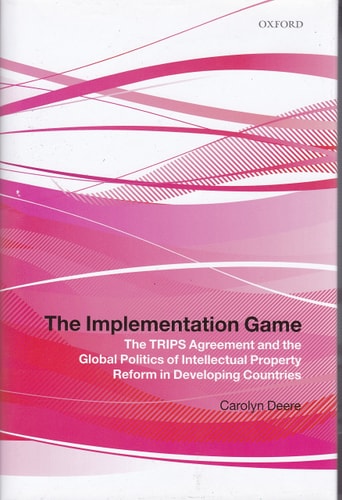
The Implementation Game: The TRIPS Agreement and the Global Politics of Intellectual Property Reform in Developing Countries
0
0
As an Amazon Associate and affiliate partner, Menrva Books earns from qualifying purchases. Learn more
Author Description
With the launch of the World Trade Organization (WTO) in 1995, its Agreement on Trade-Related Aspects of Intellectual Property Rights (TRIPS) emerged as a symbol of coercion in international economic relations. In the decade that followed, intellectual property became one of the most contentious topics of global policy debate. The Implementation Game is the first full-length study of the politics surrounding what developing countries did to implement TRIPS and why.Based on a review of the evidence from 1995 to 2007, this book emphasizes that developing countries exhibited considerable variation in their approach to TRIPS implementation. In particular, developing countries took varying degrees of advantage of the legal safeguards and options-commonly known as TRIPS 'flexibilities'--that the Agreement provides.To explain this variation, The Implementation Game argues that TRIPS implementation must be understood as a complex political game played out among developing country governments and a range of stakeholders-developed countries, non-governmental organizations (NGOs), intergovernmental organizations (IGOs), and industry groups. The contested nature of the TRIPS bargain spurred competing efforts to revise the terms of TRIPS and to influence global IP regulation more broadly. The intensity of the implementation game was amplified by an awareness among the various stakeholders that the IP reforms developing countries pursued would influence these ongoing international negotiations. The book attributes the variation in TRIPS implementation to the interplay between these global IP debates, international power pressures, and political dynamics within developing countries, and includes historical analysis, compilations of evidence, and analysis supported by examples from across the developing world.The Implementation Game will be of interest both to scholars of international relations, law, and international political economy as well as to policymakers, commentators, and activists engaged in debates on the global governance of intellectual property.
Menrva's Summary
THE THESIS
How do developing nations navigate the complex legal and political pressures of implementing the WTO's TRIPS Agreement? Carolyn Deere examines the period between 1995 and 2007 to analyze why developing countries adopted varying strategies when incorporating international intellectual property standards into their domestic legal frameworks. By evaluating the interplay between global power dynamics and local political interests, the author argues that implementation is not a uniform process but a strategic game played among diverse stakeholders, including NGOs, industry groups, and international organizations.
THE SCOPE MAP
What You Will Find
- A comprehensive analysis of TRIPS implementation strategies across various developing nations from 1995 to 2007.
- An examination of the legal safeguards and flexibilities available within the TRIPS Agreement.
- A detailed study of the influence exerted by developed countries, NGOs, and IGOs on domestic IP policy.
- Historical evidence and comparative case studies illustrating the political dynamics of global IP regulation.
THE AUTHORITY PERSPECTIVE
Scholars and policymakers recognize this work as a foundational text for understanding the intersection of international trade law and political economy. Readers frequently note the academic rigor and the clarity with which the author maps the complex web of global intellectual property negotiations.
Page Count:
432
Publication Date:
2009-01-15
Publisher:
Oxford University Press
ISBN-10:
0199550611
ISBN-13:
9780199550616
Economics
Globalization
Law
Intellectual Property
International relations
Community Tags
Similar Books








Reader Comments
Share Your Thoughts
No comments yet. Be the first to share your thoughts!