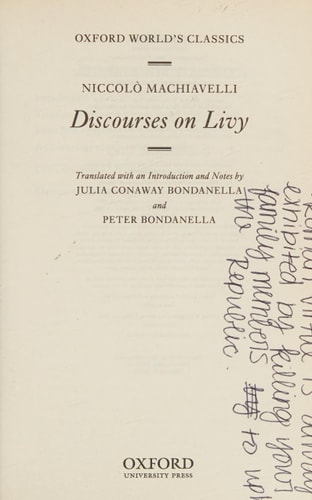
Discourses on Livy
0
0
As an Amazon Associate and affiliate partner, Menrva Books earns from qualifying purchases. Learn more
Author Description
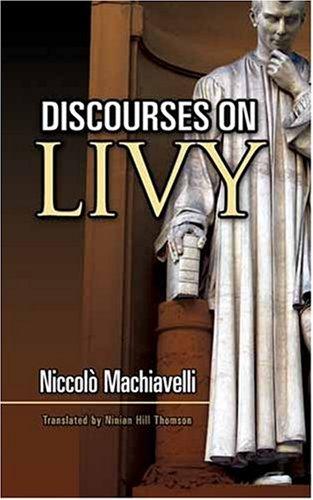
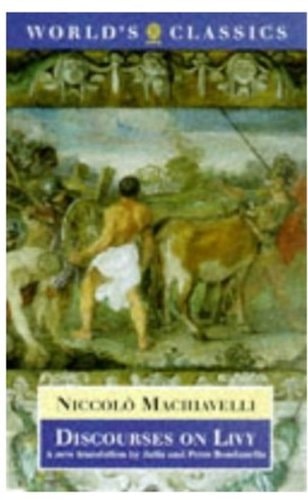
Discourses on Livy, written in 1531, is as essential to an understanding of Machiavelli as his famous treatise, The Prince. Equally controversial, it reveals his fundamental preference for a republican state.Comparing the practice of the ancient Romans with that of his contemporaries provided Machiavelli with a consistent point of view in all his works. Machiavelli's close analysis of Livy's history of Rome led him to advance his most original and outspoken view of politics--the belief that a healthy political body was characterized by social friction and conflict rather than by rigid stability. His discussion of conspiracies in Discourses on Livy is one of the most sophisticated treatments of archetypal political upheaval ever written. In an age of increasing political absolutism, Machiavelli's theories became a dangerous ideology.This new translation is richly annotated, providing the contemporary reader with sufficient historical, linguistic, and political information to understand and interpret the revolutionary affirmations Machiavelli made, based on the historical evidence he found in Livy.About the Series: For over 100 years Oxford World's Classics has made available the broadest spectrum of literature from around the globe. Each affordable volume reflects Oxford's commitment to scholarship, providing the most accurate text plus a wealth of other valuable features, including expert introductions by leading authorities, voluminous notes to clarify the text, up-to-date bibliographies for further study, and much more.
Menrva's Summary
THE THESIS
This work investigates the fundamental requirements for maintaining a stable and healthy republic by analyzing the historical successes and failures of the Roman state. Niccolò Machiavelli, a seasoned Florentine diplomat and political theorist, utilizes the historical accounts of Titus Livy to construct a framework for republican governance. He argues that political vitality is not derived from static order, but rather from the productive friction and conflict inherent in a society where power is balanced among competing interests.
THE SCOPE MAP
What You Will Find
- A comparative analysis of ancient Roman political structures versus 16th-century Italian city-states.
- A detailed examination of political conspiracies and the mechanics of state upheaval.
- Theoretical arguments regarding the necessity of civic virtue and the role of the military in a republic.
- Historical evidence drawn from Livy's 'Ab Urbe Condita' to support Machiavelli's political philosophy.
THE AUTHORITY PERSPECTIVE
Scholars and political scientists regard this text as a foundational pillar of republican theory that provides a necessary counterpoint to the more cynical observations found in 'The Prince'. Readers frequently note the academic density of the prose, which requires careful attention to the historical context of the Renaissance to fully grasp the author's intent.
Page Count:
290
Publication Date:
2009-02-15
Publisher:
Oxford University Press
ISBN-10:
0199555559
ISBN-13:
9780199555550
Philosophy
History
Political Theory
Rome
Livy
Community Tags
Other Editions(13)

Phoemixx Classics Ebooks
2021
Default edition
Independently Published
2020
Independently Published
2020

Independently Published
2020

Independently Published
2020

CreateSpace Independent Publishing Platform
2018
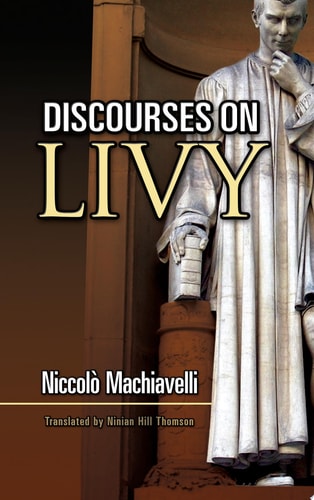
Dover Publications
2012

Dover Publications, Incorporated
2012
Oxford University Press
2009

Dover Publications
2007
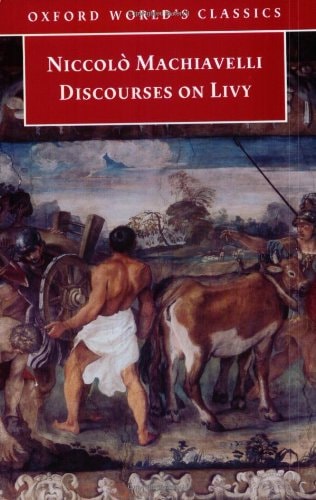
Oxford University Press
2003
2001
Oxford University Press
1997
Similar Books



Reader Comments
Share Your Thoughts
No comments yet. Be the first to share your thoughts!