Climate Change Law and Policy: EU and US Approaches
0
0
As an Amazon Associate and affiliate partner, Menrva Books earns from qualifying purchases. Learn more
Author Description
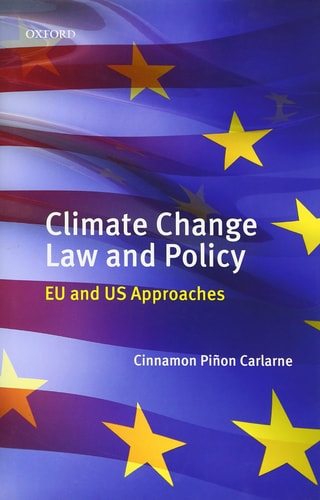
Existing climate change governance regimes in the US and the EU contain complex mixtures of regulatory, market, voluntary, and research-based strategies. The EU has adopted an approach to climate change that is based on mandatory greenhouse gas emission reductions; it is grounded in 'hard' law measures and accompanied by 'soft' law measures at the regional and Member State level. In contrast, until recently, the US federal government has carefully avoided mandatory emission reduction obligations and focused instead on employing a variety of 'soft' measures to encourage - rather than mandate - greenhouse gas emission reductions in an economically sound, market-driven manner. These macro level differences are critical yet they mask equally important transatlantic policy convergences.The US and the EU are pivotal players in the development of the international climate change regime. How these two entities structure climate change laws and policies profoundly influences the shape and success of climate change laws and policies at multiple levels of governance. This book suggests that the overall structures and processes of climate change law and policy-making in the US and the EU are intricately linked to international policy-making and, thus, the long-term success of global efforts to address climate change. Accordingly, the book analyses the content and process of climate change law and policy-making in the US and the EU to reveal policy convergences and divergences, and to examine how these convergences and divergences impact the ability of the global community to structure a sustainable, effective and equitable long-term climate strategy.
Menrva's Summary
THE THESIS
This book investigates how the divergent and convergent regulatory frameworks of the United States and the European Union shape the efficacy of global climate change governance. Cinnamon P. Carlarne, an expert in environmental law, utilizes a comparative legal analysis to contrast the EU's mandatory, hard-law approach with the US's historically market-driven, soft-law strategies. The work argues that these regional policy structures are inextricably linked to the success of international climate agreements and the development of a sustainable global strategy.
THE SCOPE MAP
What You Will Find
- Comparative analysis of EU mandatory emission reduction regimes versus US voluntary and market-based strategies.
- Examination of the interplay between regional, national, and international governance levels.
- Assessment of policy convergences and divergences in transatlantic climate legislation.
- Evaluation of how regional legal structures impact the development of equitable global climate strategies.
THE AUTHORITY PERSPECTIVE
Legal scholars and policy analysts frequently cite this work as a foundational text for understanding the structural differences between transatlantic climate governance. Experts highlight the author's ability to synthesize complex regulatory data into a coherent framework for evaluating global environmental policy.
Page Count:
350
Publication Date:
2010-11-19
Publisher:
Oxford University Press
ISBN-10:
0199553416
ISBN-13:
9780199553419
Climatic changes
Law
Climate Change
International relations
Community Tags
Similar Books