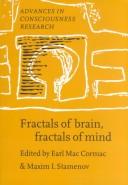
Fractals of Brain, Fractals of Mind
0
0
As an Amazon Associate and affiliate partner, Menrva Books earns from qualifying purchases. Learn more
Author Description
This collective volume is the first to discuss systematically what are the possibilities to model different aspects of brain and mind functioning with the formal means of fractal geometry and deterministic chaos. At stake here is not an approximation to the way of actual performance, but the possibility of brain and mind to implement nonlinear dynamic patterns in their functioning. The contributions discuss the following topics (among others): the edge-of-chaos dynamics in recursively organized neural systems and in intersensory interaction, the fractal timing of the neural functioning on different scales of brain networking, aspects of fractal neurodynamics and quantum chaos in novel biophysics, the fractal maximum-power evolution of brain and mind, the chaotic dynamics in the development of consciousness, etc. It is suggested that the 'margin' of our capacity for phenomenal experience, are 'fractal-limit phenomena'. Here the possibilities to prove the plausibility of fractal modeling with appropriate experimentation and rational reconstruction are also discussed. A conjecture is made that the brain vs. mind differentiation becomes possible, most probably, only with the imposition of appropriate symmetry groups implementing a flowing interface of features of local vs. global brain dynamics.
Menrva's Summary
THE THESIS
This volume explores the application of fractal geometry and deterministic chaos to model brain and mind functioning. It investigates the potential for nonlinear dynamic patterns in neural systems, intersensory interaction, and the development of consciousness, rather than approximating actual performance. The book examines topics such as edge-of-chaos dynamics, fractal timing in neural networks, fractal neurodynamics, quantum chaos, and the fractal evolution of brain and mind. It also considers the role of symmetry groups in differentiating brain and mind and discusses experimental validation of fractal modeling.
THE SCOPE MAP
- Edge-of-chaos dynamics in recursively organized neural systems
- Fractal timing of neural functioning across different brain network scales
- Fractal neurodynamics and quantum chaos in biophysics
- Fractal maximum-power evolution of brain and mind
- Chaotic dynamics in the development of consciousness
- The concept of 'fractal-limit phenomena' for phenomenal experience
- Experimental approaches to validating fractal modeling
- The role of symmetry groups in brain vs. mind differentiation
THE AUTHORITY PERSPECTIVE
This collection is noted for being the first to systematically address the modeling of brain and mind functions using fractal geometry and deterministic chaos. The contributions are recognized for their exploration of nonlinear dynamics within neural systems and cognitive processes. The book is considered a significant academic work for its theoretical discussions on consciousness, neurodynamics, and the potential for experimental verification of fractal models. Its focus on advanced mathematical concepts suggests it is aimed at researchers and specialists in neuroscience, cognitive science, and theoretical physics.
Page Count:
359
Publication Date:
1996-01-01
ISBN-10:
9027251274
ISBN-13:
9789027251275
Non-Fiction
Science
Mathematics
Chaos Theory
Neuroscience
Fractals
Community Tags
Similar Books