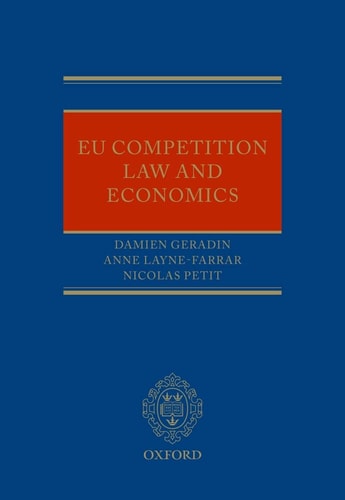
EU Competition Law and Economics
0
0
As an Amazon Associate and affiliate partner, Menrva Books earns from qualifying purchases. Learn more
Author Description
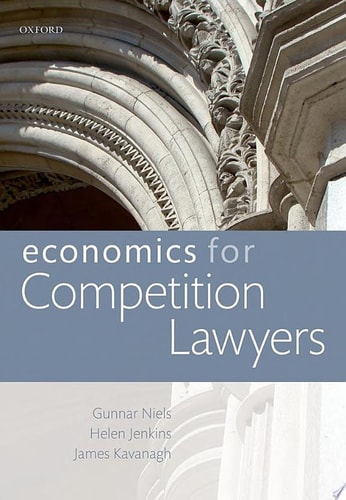
This is the first EU competition law treatise that fully integrates economic reasoning in its treatment of the decisional practice of the European Commission and the case-law of the European Court of Justice. Since the European Commission's move to a "more economic approach" to competition law reasoning and decisional practice, the use of economic argument in competition law cases has become a stricter requirement. Many national competition authorities are also increasingly moving away from a legalistic analysis of a firm's conduct to an effect-based analysis of such conduct, indeed most competition cases today involve teams composed of lawyers and industrial organisation economists.Competition law books tend to have either only cursory coverage of economics, have separate sections on economics, or indeed are far too technical in the level of economic understanding they assume. Ensuring a genuinely integrated approach to legal and economic analysis, this major new work is written by a team combining the widely recognised expertise of two competition law practitioners and a prominent economic consultant. The book contains economic reasoning throughout in accessible form, and, more pertinently for practitioners, examines economics in the light of how it is used and put to effect in the courts and decision-making institutions of the EU. A general introductory section sets EU competition law in its historical context. The second chapter goes on to explore the economics foundations of EU Competition law. What follows then is an integrated treatment of each of the core substantive areas of EU competition law, including Article 101 TFEU, Article 102 TFEU, mergers, cartels and other horizontal agreements, vertical restraints and technology transfer agreements.
Menrva's Summary
THE THESIS
This work investigates how the integration of economic reasoning into legal frameworks has fundamentally altered the application and interpretation of European Union competition law. The authors, a team consisting of legal practitioners and an economic consultant, argue that the European Commission's shift toward an effect-based analysis necessitates a unified approach where legal doctrine and industrial organization economics are treated as inseparable components of case strategy. By bridging the gap between abstract economic theory and practical courtroom application, the text provides a framework for understanding how competition authorities evaluate firm conduct in the modern regulatory environment.
THE SCOPE MAP
What You Will Find
- Historical context of EU competition law and its evolution toward an economic approach
- Foundational economic principles applied to legal decision-making
- Integrated analysis of Article 101 and 102 TFEU
- Practical examination of mergers, cartels, vertical restraints, and technology transfer agreements
THE AUTHORITY PERSPECTIVE
Legal practitioners and academics frequently identify this text as a primary resource for navigating the intersection of EU law and economic theory. Experts highlight the book's success in maintaining accessibility while providing the technical depth required for complex antitrust litigation.
Page Count:
552
Publication Date:
2012-05-16
Publisher:
Oxford University Press
ISBN-10:
0199566569
ISBN-13:
9780199566563
Economics
Competition Law
Law
Categories
Kindle eBooks
Antitrust Law
Antitrust
Professional Career & Trade
Kindle Store
European Union
Business Law
Community Tags
Similar Books