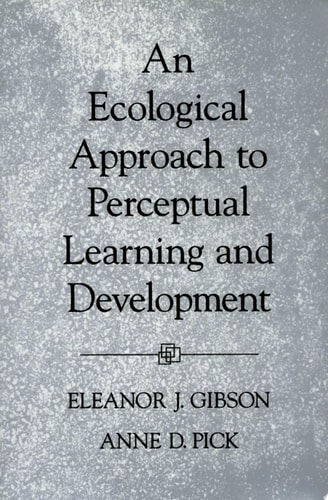
An Ecological Approach to Perceptual Learning and Development
0
0
As an Amazon Associate and affiliate partner, Menrva Books earns from qualifying purchases. Learn more
Author Description
The essential nature of learning is primarily thought of as a verbal process or function, but this notion conveys that pre-linguistic infants do not learn. Far from being "blank slates" that passively absorb environmental stimuli, infants are active learners who perceptually engage their environments and extract information from them before language is available. The ecological approach to perceiving--defined as "a theory about perceiving by active creatures who look and listen and move around"--was spearheaded by Eleanor and James Gibson in the 1950s and culminated in James Gibson's last book in 1979. Until now, no comprehensive theoretical statement of ecological development has been published since Eleanor Gibson's Principles of Perceptual Learning and Development (1969). In An Ecological Approach to Perceptual Learning and Development, distinguished experimental psychologists Eleanor J. Gibson and Anne D. Pick provide a unique theoretical framework for the ecological approach to understanding perceptual learning and development. Perception, in accordance with James Gibson's views, entails a reciprocal relationship between a person and his or her environment: The environment provides resources and opportunities for the person, and the person gets information from and acts on the environment. The concept of affordance is central to this idea; the person acts on what the environment affords, as it is appropriate. This extraordinary volume covers the development of perception in detail from birth through toddlerhood, beginning with the development of communication, going on to perceiving and acting on objects, and then to locomotion. It is more than a presentation of facts about perception as it develops. It outlines the ecological approach and shows how it underlies "higher" cognitive processes, such as concept formation, as well as discovery of the basic affordances of the environment. This impressive work should serve as the capstone for Eleanor J. Gibson's disti
Menrva's Summary
THE THESIS
This work investigates how infants and children actively extract information from their environment to facilitate perceptual learning and cognitive development. The authors, distinguished experimental psychologists Eleanor J. Gibson and Anne D. Pick, challenge the notion that learning is exclusively a linguistic process. By utilizing the ecological framework established by James Gibson, they argue that perception is a reciprocal relationship where active agents identify environmental affordances to guide their actions and cognitive growth.
THE SCOPE MAP
What You Will Find
- A comprehensive theoretical framework for ecological perceptual learning
- Analysis of developmental stages from birth through toddlerhood
- Examination of communication, object interaction, and locomotion
- Integration of higher cognitive processes like concept formation
Scope Limits
- Does not focus on clinical pathology or neurological disorders
- Does not provide a broad survey of non-ecological psychological theories
THE AUTHORITY PERSPECTIVE
Experts recognize this volume as a foundational text that bridges the gap between early sensory engagement and complex cognitive development. Readers frequently note the academic density of the prose, which serves as a definitive reference for students and researchers in developmental psychology.
Page Count:
242
Publication Date:
2003-01-01
Publisher:
Oxford University Press
ISBN-10:
0190290129
ISBN-13:
9780190290122
Psychology
Kindle Store
Counseling Psychology
Categories
Schools & Teaching
Kindle eBooks
Educational Theory
Education Theory
Developmental Psychology
Perception
Professional Career & Trade
Cognitive
Community Tags
Similar Books












Reader Comments
Share Your Thoughts
No comments yet. Be the first to share your thoughts!