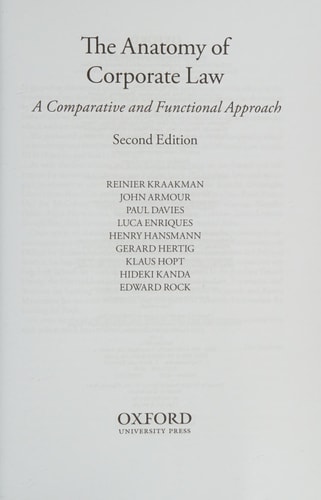
The Anatomy of Corporate Law: A Comparative and Functional Approach, Second Edition
0
0
As an Amazon Associate and affiliate partner, Menrva Books earns from qualifying purchases. Learn more
Author Description
This is the long-awaited second edition of this highly regarded comparative overview of corporate law. This edition has been comprehensively updated to reflect profound changes in corporate law. It now includes consideration of additional matters such as the highly topical issue of enforcement in corporate law, and explores the continued convergence of corporate law across jurisdictions.The authors start from the premise that corporate (or company) law across jurisdictions addresses the same three basic agency problems: (1) the opportunism of managers vis-à-vis shareholders; (2) the opportunism of controlling shareholders vis-à-vis minority shareholders; and (3) the opportunism of shareholders as a class vis-à-vis other corporate constituencies, such as corporate creditors and employees. Every jurisdiction must address these problems in a variety of contexts, framed by the corporation's internal dynamics and its interactions with the product, labor, capital, and takeover markets. The authors' central claim, however, is that corporate (or company) forms are fundamentally similar and that, to a surprising degree, jurisdictions pick from among the same handful of legal strategies to address the three basic agency issues.This book explains in detail how and why the principal European jurisdictions, Japan, and the United States sometimes select identical legal strategies to address a given corporate law problem, and sometimes make divergent choices. After an introductory discussion of agency issues and legal strategies, the book addresses the basic governance structure of the corporation, including the powers of the board of directors and the shareholders meeting. It proceeds to creditor protection measures, related-party transactions, and fundamental corporate actions such as mergers and charter amendments. Finally, it concludes with an examination of friendly acquisitions, hostiletakeovers, and the regulation of the capital markets.
Menrva's Summary
THE THESIS
This book investigates whether corporate law systems across diverse global jurisdictions converge toward similar legal strategies to resolve fundamental agency problems. The authors, a distinguished group of international legal scholars and practitioners, utilize a functional comparative framework to analyze how different nations address the inherent conflicts between managers, shareholders, and other corporate stakeholders. By examining the internal dynamics of corporations alongside external market pressures, the text argues that despite varying legal traditions, jurisdictions frequently employ a limited set of identical strategies to mitigate agency costs.
THE SCOPE MAP
What You Will Find
- Comparative analysis of corporate governance structures in Europe, Japan, and the United States.
- Examination of three core agency problems: manager-shareholder, controlling-minority shareholder, and shareholder-constituency conflicts.
- Detailed review of legal mechanisms including board powers, creditor protection, and related-party transaction regulations.
- Analysis of market-based corporate actions such as mergers, charter amendments, and hostile takeovers.
THE AUTHORITY PERSPECTIVE
Legal scholars and practitioners recognize this work as a foundational text for understanding the functional convergence of global corporate law. Readers frequently note the academic density of the prose, which provides a rigorous and systematic approach to complex regulatory frameworks.
Page Count:
322
Publication Date:
2009-09-28
Publisher:
Oxford University Press
ISBN-10:
019956583X
ISBN-13:
9780199565832
Business
Economics
Corporate Law
Law
Comparative Law
Community Tags
Similar Books












Reader Comments
Share Your Thoughts
No comments yet. Be the first to share your thoughts!