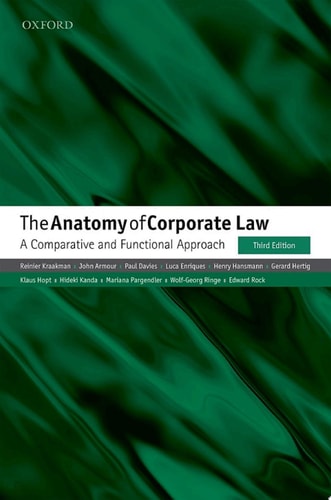
The Anatomy of Corporate Law: A Comparative and Functional Approach
0
0
As an Amazon Associate and affiliate partner, Menrva Books earns from qualifying purchases. Learn more
Author Description
This is the long-awaited third edition of this highly regarded comparative overview of corporate law. This edition has been comprehensively revised and updated to reflect the profound changes in corporate law and governance practices that have taken place since the previous edition. These include numerous regulatory changes following the financial crisis of 2007-09 and the changing landscape of governance, especially in the US, with the ever more central role of institutional investors as (active) owners of corporations. The geographic scope of the coverage has been broadened to include an important emerging economy, Brazil. In addition, the book now incorporates analysis of the burgeoning use of corporate law to protect the interests of "external constituencies" without any contractual relationship to a company, in an attempt to tackle broader social and economic problems. The authors start from the premise that corporations (or companies) in all jurisdictions share the same key legal attributes: legal personality, limited liability, delegated management, transferable shares, and investor ownership. Businesses using the corporate form give rise to three basic types of agency problems: those between managers and shareholders as a class; controlling shareholders and minority shareholders; and shareholders as a class and other corporate constituencies, such as corporate creditors and employees. After identifying the common set of legal strategies used to address these agency problems and discussing their interaction with enforcement institutions, The Anatomy of Corporate Law illustrates how a number of core jurisdictions around the world deploy such strategies. In so doing, the book highlights the many commonalities across jurisdictions and reflects on the reasons why they may differ on specific issues. The analysis covers the basic governance structure of the corporation, including the powers of the board of directors and the shareholder meeting, both when management
Menrva's Summary
THE THESIS
This text investigates how diverse global jurisdictions utilize a common set of legal strategies to address the fundamental agency problems inherent in the corporate form. The authors, a distinguished group of international legal scholars and practitioners, utilize a functional comparative framework to analyze how different legal systems manage the conflicts between managers, shareholders, and external stakeholders. By focusing on shared legal attributes such as limited liability and delegated management, the book provides a systematic method for evaluating the efficacy of corporate governance across various economic landscapes.
THE SCOPE MAP
What You Will Find
- Analysis of agency problems involving managers, controlling shareholders, and external constituencies.
- Comparative study of corporate law frameworks in the US, Brazil, and other core jurisdictions.
- Examination of regulatory shifts following the 2007-09 financial crisis.
- Discussion of the role of institutional investors in modern corporate governance.
Scope Limits
- Does not provide a comprehensive legal manual for specific local compliance or litigation procedures.
- Excludes detailed historical analysis of corporate law prior to the modern era.
THE AUTHORITY PERSPECTIVE
Legal scholars and practitioners frequently cite this work as a foundational text for understanding the functional mechanics of global corporate governance. Readers often note the academic density of the prose, which is tailored for advanced students and professionals in the field of comparative law.
Page Count:
299
Publication Date:
2017-01-01
Publisher:
OUP Oxford
ISBN-10:
0191059544
ISBN-13:
9780191059544
Business
Economics
Corporate Law
Governance
Professional Career & Trade
Law
Comparative Law
Community Tags
Similar Books













Reader Comments
Share Your Thoughts
No comments yet. Be the first to share your thoughts!