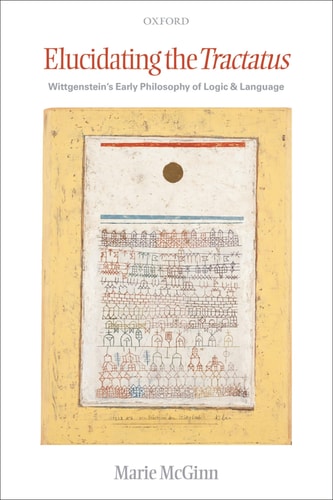
Elucidating the Tractatus: Wittgenstein's Early Philosophy of Logic and Language
0
0
As an Amazon Associate and affiliate partner, Menrva Books earns from qualifying purchases. Learn more
Author Description
Discussion of Wittgenstein's Tractatus is currently dominated by two opposing interpretations of the work: a metaphysical or realist reading and the "resolute" reading of Diamond and Conant. Marie McGinn's principal aim in this book is to develop an alternative interpretative line, which rejects the idea; central to the metaphysical reading, that Wittgenstein sets out to ground the logic of our language in features of an independently constituted reality, but which allows that he aims to provide positive philosophical insights into how language functions.McGinn takes as a guiding principle the idea that we should see Wittgenstein's early work as an attempt to eschew philosophical theory and to allow language itself to reveal how it functions. By this account, the aim of the work is to elucidate what language itself makes clear, namely, what is essential to its capacity to express thoughts that are true or false. However, the early Wittgenstein undertakes this descriptive project in the grip of a set of preconceptions concerning the essence of language that determine both how he conceives the problem and the approach he takes to the task of clarification. Nevertheless, the Tractatus contains philosophical insights, achieved despite his early preconceptions, that form the foundation of his later philosophy.The anti-metaphysical interpretation that is presented includes a novel reading of the problematic opening sections of the Tractatus, in which the apparently metaphysical status of Wittgenstein's remarks is shown to be an illusion. The book includes a discussion of the philosophical background to the Tractatus, a comprehensive interpretation of Wittgenstein's early views of logic and language, and an interpretation of the remarks on solipsism. The final chapter is a discussion of the relation between the early and the later philosophy that articulates the fundamental shift in Wittgenstein's approach to the task of understanding how language functions and reveal the still more fundamental continuity in his conception of his philosophical task.
Menrva's Summary
THE THESIS
This book investigates whether Wittgenstein's Tractatus Logico-Philosophicus can be interpreted as a descriptive project that avoids metaphysical grounding while still providing positive insights into the nature of language. Marie McGinn, a scholar of Wittgenstein's work, challenges the dominant binary between metaphysical and resolute interpretations. She argues that Wittgenstein sought to allow language to reveal its own functional essence, even while he remained constrained by his own early philosophical preconceptions.
THE SCOPE MAP
What You Will Find
- A critical analysis of the opening sections of the Tractatus to debunk perceived metaphysical claims.
- An examination of the philosophical background and historical context influencing Wittgenstein's early thought.
- A detailed interpretation of Wittgenstein's views on logic, language, and the nature of solipsism.
- A comparative study linking the early Tractatus framework to the fundamental shifts in Wittgenstein's later philosophical methodology.
THE AUTHORITY PERSPECTIVE
Scholars and students of analytic philosophy frequently cite this work as a significant contribution to the ongoing debate regarding Wittgenstein's interpretative framework. Readers often note the academic density of the prose, which requires a strong foundational knowledge of the Tractatus to fully appreciate the author's nuanced arguments.
Page Count:
336
Publication Date:
2009-09-28
Publisher:
Oxford University Press
ISBN-10:
0199568243
ISBN-13:
9780199568246
Philosophy
Language
Logic
Epistemology
Great Britain
Metaphysics
Community Tags
Similar Books


Reader Comments
Share Your Thoughts
No comments yet. Be the first to share your thoughts!