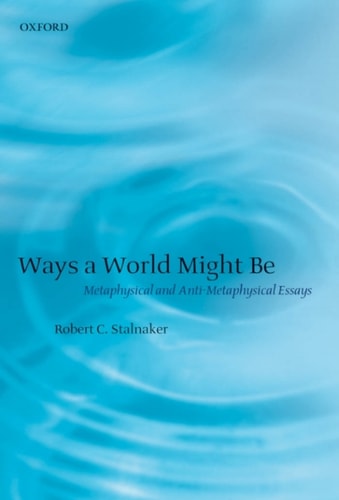
Ways a World Might Be: Metaphysical and Anti-Metaphysical Essays
0
0
As an Amazon Associate and affiliate partner, Menrva Books earns from qualifying purchases. Learn more
Author Description
Ways a World Might Be collects, and adds to, Robert Stalnaker's published papers on metaphysical issues. The central theme that runs throughout the book is the role of possible worlds in articulating our various metaphysical commitments. The essays contain both reflections on the general idea of a space of possibilities and attempts to use the framework of possible worlds to formulate and clarify semantic and metaphysical questions about properties and individuals, supervenience and essentialism, reference, thought and experience. The essays also reflect on the nature of metaphysics, and on the relation between metaphysical and semantic questions - questions about what there is and questions about how we talk and think about what there is. The book begins by asking what possible worlds are, and how we are able to represent and know about them. Stalnaker argues that we can take possibilities seriously without embracing the kind of modal realism that David Lewis defended, and can take them as fundamental without purporting to offer a reductive account of modality. He then turns to questions about the nature of properties and relations and their role in carving up a space of possibilities, and to questions about the nature of individuals, and the way they are identified across time and possible worlds. The essays in the last two sections of the book are concerned with the interaction of metaphysical and semantic issues, and with the place of subjective experience in our conception of an objective world as it is in itself. Two of the fourteen essays, plus an extensive introduction that sets the papers in context and makes explicit some of the essays' common threads, are published here for the first time.
Menrva's Summary
THE THESIS
This collection investigates the utility and ontological status of possible worlds as a framework for addressing fundamental metaphysical and semantic questions. Robert C. Stalnaker, a prominent figure in analytic philosophy, draws upon his extensive body of work to argue that possible worlds can serve as a robust conceptual tool without necessitating the extreme modal realism proposed by other theorists. By examining the intersection of language, thought, and objective reality, the author provides a structured approach to understanding properties, individuals, and the nature of existence itself.
THE SCOPE MAP
What You Will Find
- Analysis of the nature of possible worlds and modal representation
- Philosophical inquiries into properties, relations, and essentialism
- Examination of identity across time and potential states of being
- Exploration of the relationship between semantic inquiry and metaphysical reality
Scope Limits
- Does not provide a reductive account of modality
- Excludes detailed engagement with non-analytic traditions of metaphysics
THE AUTHORITY PERSPECTIVE
Scholars and students of analytic philosophy frequently identify this work as a critical resource for understanding the development of modal semantics and contemporary metaphysical discourse. Readers often note the high level of technical rigor in the prose, which assumes a foundational familiarity with formal logic and linguistic philosophy.
Page Count:
304
Publication Date:
2003-01-01
Publisher:
Clarendon Press
ISBN-10:
0191530743
ISBN-13:
9780191530746
Philosophy
Semantics
Logic
Metaphysics
Epistemology
Community Tags
Similar Books