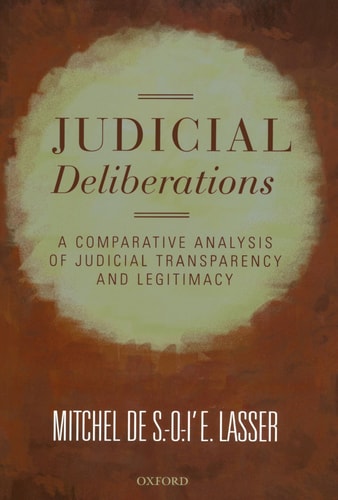
Judicial Deliberations: A Comparative Analysis of Transparency and Legitimacy
0
0
As an Amazon Associate and affiliate partner, Menrva Books earns from qualifying purchases. Learn more
Author Description
Judicial Deliberations compares how and why the European Court of Justice, the French Cour de cassation and the US Supreme Court offer different approaches for generating judicial accountability and control, judicial debate and deliberation, and ultimately judicial legitimacy.Examining the judicial argumentation of the United States Supreme Court and of the French Cour de cassation, the book first reorders the traditional comparative understanding of the difference between French civil law and American common law judicial decision-making. It then uses this analysis to offer the first detailed comparative examination of the interpretive practice of the European Court of Justice.Lasser demonstrates that the French judicial system rests on a particularly unified institutional and ideological framework founded on explicitly republican notions of meritocracy and managerial expertise. Law-making per se may be limited to the legislature; but significant judicial normative administration is entrusted to State selected, trained, and sanctioned elites who are policed internally through hierarchical institutional structures. The American judicial system, by contrast, deploys a more participatory and democratic approach that reflects a more populist vision. Shunning the unifying, controlling, and hierarchical French structures, the American judicial system instead generates its legitimacy primarily by argumentative means. American judges engage in extensive debates that subject them to public scrutiny and control. The ECJ hovers delicately between the institutional/argumentative and republican/democratic extremes. On the one hand, the ECJ reproduces the hierarchical French discursive structure on which it was originally patterned. On the other, it transposes this structure into a transnational context of fractured political and legal assumptions. This drives the ECJ towards generating legitimacy by adopting a somewhat more transparent argumentative approach.
Menrva's Summary
THE THESIS
This work investigates how the European Court of Justice, the French Cour de cassation, and the United States Supreme Court construct judicial legitimacy through distinct institutional and argumentative frameworks. Mitchel de S.-O.-l'E. Lasser, a scholar of comparative law, utilizes a rigorous analytical approach to contrast the hierarchical, meritocratic traditions of the French civil law system with the participatory, debate-driven model of the American common law system. By examining these divergent methodologies, the author provides a framework for understanding how the European Court of Justice navigates the tension between these two institutional paradigms within a transnational context.
THE SCOPE MAP
What You Will Find
- Comparative analysis of judicial decision-making processes in France, the United States, and the European Union.
- Examination of the institutional and ideological foundations of civil law versus common law systems.
- Detailed study of the European Court of Justice's interpretive practices and its struggle for transparency.
- Evaluation of how judicial accountability and normative administration influence institutional legitimacy.
THE AUTHORITY PERSPECTIVE
Legal scholars and practitioners frequently cite this text as a foundational study for understanding the structural differences between European and American judicial systems. Readers often note the academic density of the prose, which provides a comprehensive and nuanced examination of comparative legal theory.
Page Count:
396
Publication Date:
2009-09-28
Publisher:
Oxford University Press
ISBN-10:
0199575169
ISBN-13:
9780199575169
Comparative Law
Professional Career & Trade
European Law
United States
Court of justice of the european communities
Law
Community Tags
Other Editions(2)
Similar Books













Reader Comments
Share Your Thoughts
No comments yet. Be the first to share your thoughts!