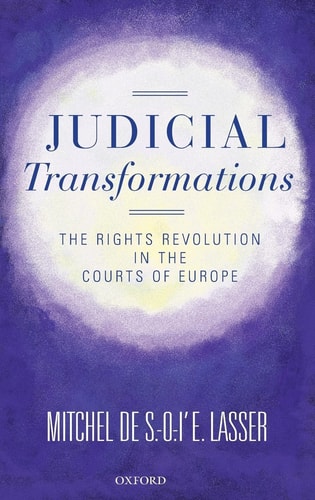
Judicial Transformations: The Rights Revolution in the Courts of Europe
0
0
As an Amazon Associate and affiliate partner, Menrva Books earns from qualifying purchases. Learn more
Author Description
Fundamental rights are exploding across all areas of law in Europe. This rights revolution is transforming European judicial culture and the judge's political role at breakneck speed. Not only have fundamental rights become an integral part of litigation in the domestic and European courts, but their advent has provoked an ongoing revolution in French and European procedural, doctrinal, institutional and conceptual structures.Grounded in comparative law and political science, this book tells the story of the rights revolution. Part of the story is social and intellectual. As the polity has become increasingly complicated both nationally and transnationally, fundamental rights have emerged as a lingua franca within and across European jurisdictions: they offer a pool of common legal terms that address the diversity of interests now litigating in the domestic and European courts.But that is not the entire story. The fundamental rights revolution is also a product of the complex - and often competitive - inter-institutional dynamics that characterize the judicial arena in our ever more globalized legal space. European legal controversies increasingly play out at the jurisdictional intersection of a range of domestic and supranational high courts, which must interact and coordinate as never before. This growing inter-institutional interface has taken on a competitive logic and inflationary force of its own.The result has been a group dynamic that has reinforced the ubiquity and preeminence of fundamental rights throughout the European legal field. Almost every European judicial player now faces powerful pressures to jump on the fundamental rights bandwagon or be left intellectually and institutionally behind. This has prompted a frantic race to master and lead the emergent fundamental rights regime.In telling the story of the rights revolution, the book makes a substantial contribution to understanding the current dynamics of European judiciaries, and the depth of the impact of transnational law on domestic legal culture.
Menrva's Summary
THE THESIS
This book investigates the rapid expansion of fundamental rights within European legal systems and the subsequent transformation of judicial culture and institutional roles. Mitchel de S.-O.-l'E. Lasser, a scholar of comparative law, utilizes a framework grounded in both legal doctrine and political science to analyze this shift. He argues that the rise of fundamental rights is not merely a social or intellectual evolution, but a direct consequence of competitive inter-institutional dynamics between domestic and supranational courts. By examining these pressures, the author illustrates how the race to control the rights regime has fundamentally altered the European legal landscape.
THE SCOPE MAP
What You Will Find
- Analysis of the inter-institutional dynamics between domestic and supranational high courts in Europe.
- Examination of the procedural, doctrinal, and institutional shifts caused by the rights revolution.
- Integration of comparative law methodology with political science theories of judicial behavior.
- Evaluation of how fundamental rights function as a common legal language across diverse European jurisdictions.
THE AUTHORITY PERSPECTIVE
Legal scholars and practitioners recognize this work as a significant contribution to the understanding of modern European judicial behavior and the complexities of transnational legal integration. Readers frequently note the academic density of the prose, which provides a rigorous examination of the competitive pressures shaping contemporary high courts.
Page Count:
330
Publication Date:
2009-09-28
Publisher:
Oxford University Press
ISBN-10:
0199570779
ISBN-13:
9780199570775
Justice Administration of
European Law
Human rights
Comparative Law
Law
Law europe
Community Tags
Similar Books