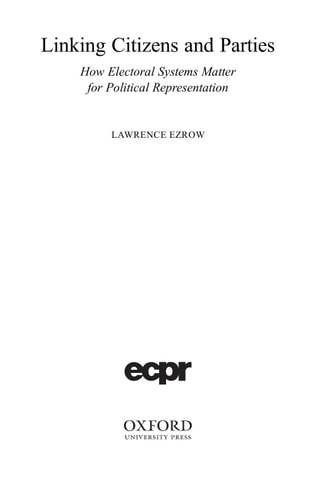
Linking Citizens and Parties: How Electoral Systems Matter for Political Representation
0
0
As an Amazon Associate and affiliate partner, Menrva Books earns from qualifying purchases. Learn more
Author Description
Linking Citizens and Parties addresses familiar questions about political representation: Are parties responsive to their core supporters or to the public in general? Do parties that adopt centrist policy positions benefit in elections? Does proportional representation encourage party extremism? These fundamental questions about democracy are paired with the empirical observation of Western European democracies during the last thirty years. The study highlights the pathways (mainstream and niche) through which citizens' political preferences are expressed by their political parties. It concludes with a positive evaluation of these democracies as their citizens have access to at least one, and possibly both niche and mainstream pathways.
Menrva's Summary
THE THESIS
This book investigates how electoral systems and party strategies influence the degree of political representation within Western European democracies. Lawrence Ezrow, a scholar of comparative politics, utilizes empirical data from the past three decades to analyze the relationship between voter preferences and party policy positioning. The work argues that democratic systems provide multiple pathways for citizen representation, specifically through mainstream and niche party channels, which collectively ensure that diverse public interests are addressed.
THE SCOPE MAP
What You Will Find
- Empirical analysis of political party behavior in Western European democracies over a thirty-year period.
- Comparative study of mainstream versus niche party policy strategies.
- Quantitative evaluation of how proportional representation affects party extremism.
- Framework for understanding the responsiveness of political parties to core supporters versus the general electorate.
THE AUTHORITY PERSPECTIVE
Experts recognize this work as a significant contribution to the study of democratic representation and party competition. Readers frequently note the clarity of the empirical methodology used to bridge the gap between theoretical democratic models and observed political outcomes.
Page Count:
216
Publication Date:
2010-07-29
Publisher:
Oxford University Press
ISBN-10:
0199572526
ISBN-13:
9780199572526
Democracy
Electoral Systems
Comparative Politics
Voting
Community Tags
Similar Books