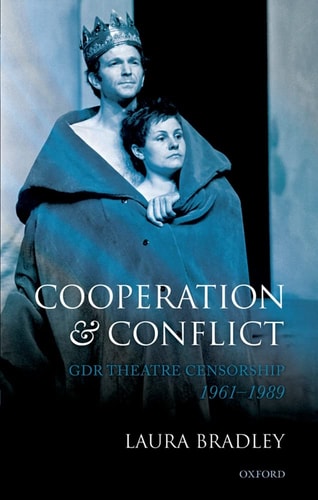
Cooperation and Conflict: GDR Theatre Censorship, 1961-1989
0
0
As an Amazon Associate and affiliate partner, Menrva Books earns from qualifying purchases. Learn more
Author Description
Despite all the evidence to the contrary, the authorities in the German Democratic Republic always denied that they practised censorship. In this fascinating new study, Laura Bradley explores how the authorities' denial affected the language and experience of theatre censorship. She shows that it left theatre practitioners doubly exposed: they remained officially responsible for their productions, even if the productions had passed pre-performance controls. In the absence of a fixed set of criteria, cultural functionaries had to make difficult judgements about which plays and productions to allow, and where to draw the line between constructive criticism and subversion. Drawing on a wealth of new archive material, the study explores how theatre practitioners and functionaries negotiated these challenges between 1961 and 1989. The chapters in Part I explore theatre censorship in East Berlin, asking how the controls affected different genres, and how theatre practitioners responded to the construction of the Berlin Wall, the Prague Spring, and the expatriation of Wolf Biermann. Part II broadens the focus to the regions, investigating why theatre practitioners complained of strong regional variations in theatre censorship, and how they responded to Mikhail Gorbachev's policies of glasnost and perestroika. By examining a range of case studies, from banned stagings to those that met with official approval, the book puts high-profile disputes back into context. It shows how censorship operated through human negotiation, illuminating the shifting patterns of cooperation and conflict that influenced the space available for theatrical experimentation.
Menrva's Summary
THE THESIS
This study investigates how the German Democratic Republic (GDR) maintained a system of theatre censorship while simultaneously denying its existence. Laura Bradley, a scholar of German theatre and culture, utilizes extensive archival research to examine the complex power dynamics between state functionaries and theatre practitioners. The book argues that the lack of codified censorship criteria forced both sides into a continuous, informal process of negotiation, which defined the boundaries of artistic expression and political subversion from 1961 to 1989.
THE SCOPE MAP
What You Will Find
- Analysis of the impact of major political events including the construction of the Berlin Wall, the Prague Spring, and the expatriation of Wolf Biermann.
- Comparative study of censorship practices between East Berlin and regional theatre centers.
- Examination of the influence of Soviet policies such as glasnost and perestroika on East German cultural control.
- Case studies of specific theatrical productions ranging from banned works to those that received official state approval.
THE AUTHORITY PERSPECTIVE
Scholars and historians recognize this work as a definitive analysis of the administrative and interpersonal mechanics of GDR cultural policy. Readers frequently note the meticulous use of archival evidence to clarify how censorship functioned as a fluid, human-driven process rather than a rigid bureaucratic mandate.
Page Count:
304
Publication Date:
2011-02-01
Publisher:
Oxford University Press
ISBN-10:
0199589631
ISBN-13:
9780199589630
History
Theater
Theatre
Censorship
European History
German history
Community Tags
Similar Books