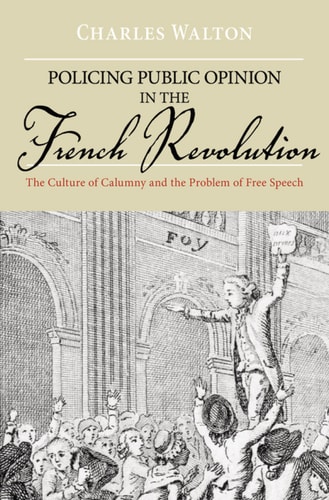
Policing Public Opinion in the French Revolution: The Culture of Calumny and the Problem of Free Speech
0
0
As an Amazon Associate and affiliate partner, Menrva Books earns from qualifying purchases. Learn more
Author Description
In the 1789 Declaration of the Rights of Man and of the Citizen, French revolutionaries proclaimed the freedom of speech, religion, and opinion. Censorship was abolished, and France appeared to be on a path towards tolerance, pluralism, and civil liberties. A mere four years later, the country descended into a period of political terror, as thousands were arrested, tried, and executed for crimes of expression and opinion. In Policing Public Opinion in the French Revolution, Charles Walton traces the origins of this reversal back to the Old Regime. He shows that while early advocates of press freedom sought to abolish pre-publication censorship, the majority still firmly believed injurious speech--or calumny--constituted a crime, even treason if it undermined the honor of sovereign authority or sacred collective values, such as religion and civic spirit. With the collapse of institutions responsible for regulating honor and morality in 1789, calumny proliferated, as did obsessions with it. Drawing on wide-ranging sources, from National Assembly debates to local police archives, Walton shows how struggles to set legal and moral limits on free speech led to the radicalization of politics, and eventually to the brutal liquidation of "calumniators" and fanatical efforts to rebuild society's moral foundation during the Terror of 1793-1794.With its emphasis on how revolutionaries drew upon cultural and political legacies of the Old Regime, this study sheds new light on the origins of the Terror and the French Revolution, as well as the history of free expression.
Menrva's Summary
THE THESIS
This book investigates the paradox of how the French Revolution, which initially championed the freedom of speech, devolved into a regime that executed citizens for their opinions. Charles Walton, a historian specializing in the intellectual and political culture of 18th-century France, argues that the roots of this contradiction lie in the Old Regime's obsession with honor and calumny. By analyzing the transition from royal censorship to revolutionary radicalization, he demonstrates how the collapse of traditional moral regulation created a vacuum that necessitated violent state intervention to protect collective values.
THE SCOPE MAP
What You Will Find
- Analysis of the 1789 Declaration of the Rights of Man and of the Citizen
- Examination of the legal and cultural evolution of 'calumny' as a political crime
- Comparative study of Old Regime censorship versus revolutionary political terror
- Synthesis of National Assembly debates and local police archives
Scope Limits
- The study focuses primarily on the ideological and political mechanisms of speech regulation rather than a comprehensive military or economic history of the period.
THE AUTHORITY PERSPECTIVE
Scholars recognize this work as a significant contribution to the intellectual history of the French Revolution, particularly regarding the origins of the Terror. Readers frequently note the academic density of the prose and the meticulous archival research that supports Walton's arguments.
Page Count:
348
Publication Date:
2009-01-01
Publisher:
Oxford University Press
ISBN-10:
0190451289
ISBN-13:
9780190451288
History
Cultural History
European History
Free Speech
Censorship
Freedom of speech
French Revolution
Community Tags
Similar Books