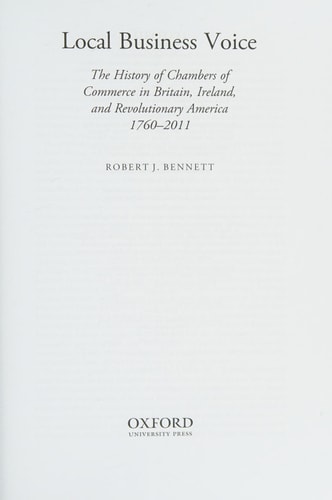
Local Business Voice: The History of Chambers of Commerce in Britain, Ireland, and Revolutionary America, 1760-2011
0
0
Author Description
Local Business Voice provides the first scholarly and systematic history of the Chambers of Commerce from early historical origins in the eighteenth century up to the present date. Based on new archival information, it provides exhaustive coverage of all UK and Irish chambers, as well as detailed examination of early Chambers in the U.S., including New York, Charleston, and Boston, and early Chambers in Quebec and Jamaica.The book traces the importance of early tax protests and anger as motivating forces through interrelation with the American Revolution. It traces the emergence of service bundles, such commercial arbitration, coffee and reading rooms, and information and consultancy services as critical to the Chambers' unique market position. Some of the services had a unique status as trust goods, exploiting the chambers' USP as high status mutual non-profit organisations. It demonstrates the challenges for the Chambers as independent voluntary bodies in increasing partnerships with governments and competition with rival institutions, and also gives critical overview of key lobbies, such as over the Jay Treaty, tax expansion, the Corn Laws, tariff reform and free trade, municipal socialism, and modern regulatory burdens.There is also extensive analysis of chamber membership and motivation, tracking changes in structure by firm size, sector and corporate and management structures. The growth of small firm membership, and the value of business networks and (in the early chambers) religious adherence, are shown as key mediums for recruitment, and maintaining commitment.A definitive account of all local chambers including data appendices and detailed assessment of their significance, the book will be an enduring resource and foundation for research into the Chambers of Commerce's origins, historical development, and modern position.
Menrva's Summary
THE THESIS
This work investigates the historical evolution, institutional development, and socio-economic influence of Chambers of Commerce across Britain, Ireland, and North America from 1760 to 2011. Robert J. Bennett utilizes extensive archival research to document how these organizations transitioned from early tax-protest groups into modern service-oriented business networks. The text argues that the unique market position of Chambers of Commerce relies on their status as non-profit, trust-based entities that balance independent advocacy with government partnership.
THE SCOPE MAP
What You Will Find
- Comprehensive historical analysis of Chambers of Commerce in the UK, Ireland, the United States, Quebec, and Jamaica.
- Examination of the role of Chambers in major political and economic events, including the American Revolution, the Jay Treaty, and the Corn Laws.
- Data-driven assessment of membership demographics, including shifts in firm size, sector representation, and the influence of business networks.
- Analysis of the evolution of service models, such as commercial arbitration, consultancy, and regulatory lobbying.
THE AUTHORITY PERSPECTIVE
Experts identify this volume as a foundational reference for the study of business history and institutional development. Readers frequently note the academic density of the prose and the exhaustive nature of the provided data appendices.
Page Count:
936
Publication Date:
2012-01-13
Publisher:
Oxford University Press
ISBN-10:
0199584737
ISBN-13:
9780199584734
Business
Economics
History
Great Britain
Ireland_commerce
British History
American History
United States
Community Tags
Similar Books