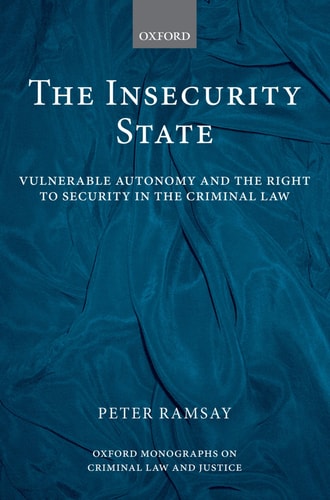
The Insecurity State: Vulnerable Autonomy and the Right to Security in the Criminal Law
0
0
As an Amazon Associate and affiliate partner, Menrva Books earns from qualifying purchases. Learn more
Author Description
The Insecurity State is a book about the recent emergence of a 'right to security' in the UK's criminal law. The Insecurity State sets out from a detailed analysis of the law of the Anti-Social Behavior Order and of the Coalition government's proposed replacement for it. It shows that the liabilities contained in both seek to protect a 'freedom from fear' and that this 'right to security' explains a lot of other recently enacted criminal offences. This book identifies the normative source of this right to security in the idea of vulnerable autonomy. It demonstrates that the vulnerability of autonomy is an axiomatic assumption of political theories that have enjoyed a preponderant influence right across the political mainstream. It considers the influence of these normative commitments on the policy of both the New Labour and the Coalition governments. The Insecurity State then explores how the wider contemporary criminal law also institutionalizes the right to security, and how this differs from the law's earlier protection of security interests. It examines the right to security, and its attendant penal liabilities, in the context of both human rights protection and normative criminal law theories. Finally the book exposes the paradoxical claims about the state's authority that are entailed by penal laws that assume the vulnerability of the normal, representative citizen.The Insecurity State offers a criminal law theory that is unorthodox in both its method and its content:- It is focused on a contemporary development in the 'special part' of the criminal law rather than the law's general principles.- It is an explanatory political sociology of substantive criminal law rather than the more familiar normative theory; but it is an explanatory theory that seeks to understand the law's historical development through an investigation of the changing character of its normative order.- It does not apply a pre-existing sociological or philosophical theory to the law; rather it develops a theoretical explanation from detailed legal analysis and reconstruction of New Labour's penal laws.- It concludes that repressive criminal laws have arisen from a deficit of political authority rather than from excessive authoritarianism.
Menrva's Summary
THE THESIS
This book investigates the emergence and implications of a 'right to security' within contemporary UK criminal law, questioning how the state's penal authority is transformed by the assumption of citizen vulnerability. Peter Ramsay, a scholar of criminal law, utilizes a political sociology framework to analyze how legislative shifts—specifically regarding anti-social behavior policies—reflect broader normative commitments to 'vulnerable autonomy.' By examining both New Labour and Coalition government policies, the author argues that modern penal liabilities prioritize a 'freedom from fear' that fundamentally alters the traditional relationship between the state and the individual.
THE SCOPE MAP
What You Will Find
- Analysis of Anti-Social Behavior Orders and their legislative successors in the UK.
- Examination of the concept of 'vulnerable autonomy' as a driver of modern criminal policy.
- Comparative study of historical security interests versus contemporary penal liabilities.
- Investigation into the intersection of human rights protections and substantive criminal law theory.
THE AUTHORITY PERSPECTIVE
Legal scholars and political theorists frequently cite this work for its unorthodox approach to criminal law, which prioritizes sociological explanation over traditional normative theory. Readers often note the academic density of the prose, identifying it as a rigorous text for those studying the intersection of state authority and modern penal policy.
Page Count:
300
Publication Date:
2012-06-18
Publisher:
Oxford University Press
ISBN-10:
0199581061
ISBN-13:
9780199581061
Nuisances
Criminal Law
Sociology
United States
Public Policy
Professional Career & Trade
Human rights
Law
Community Tags
Other Editions(2)
Similar Books

Reader Comments
Share Your Thoughts
No comments yet. Be the first to share your thoughts!