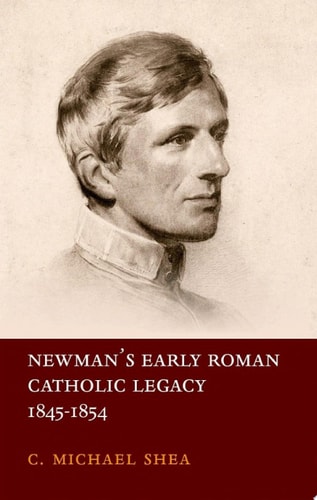
Newman's Early Roman Catholic Legacy, 1845-1854
0
0
As an Amazon Associate and affiliate partner, Menrva Books earns from qualifying purchases. Learn more
Author Description
For decades, scholars have assumed that the genius of John Henry Newman remained underappreciated among his Roman Catholic contemporaries. In order to find the true impact of his work, one must therefore look to the century following his death. Newman's Early Roman Catholic Legacy, 1845-1854 unpicks this claim. Examining a host of overlooked evidence from England and the European continent, C. Michael Shea considers letters, records of conversations, and obscure and unpublished theological exchanges to show how Newman's 1845 Essay on the Development of Christian Doctrine influenced a host of Catholic teachers, writers, and Church authorities in nineteenth-century Rome and beyond. Shea explores how these individuals employed Newman's theory of development to argue for the definability of the new dogma of the Immaculate Conception of Mary during the years preceding the doctrine's definition in 1854. This study traces how the theory of development became a factor in determining the very language that the Roman Catholic Church would use in referring to doctrinal change over time. In this way, Newman's Early Roman Catholic Legacy, 1845-1854 uncovers a key dimension of Newman's significance in modern religious history.
Menrva's Summary
THE THESIS
This study investigates the extent to which John Henry Newman's theological theories influenced Roman Catholic doctrine and intellectual discourse during the decade following his conversion. C. Michael Shea, a scholar of religious history, utilizes a range of primary source materials—including private correspondence, unpublished theological exchanges, and records of contemporary conversations—to challenge the long-held assumption that Newman's influence was delayed until the twentieth century. By focusing on the period between 1845 and 1854, Shea argues that Newman's theory of doctrinal development was actively employed by European Catholic authorities to justify the definition of the Immaculate Conception.
THE SCOPE MAP
What You Will Find
- Analysis of the reception of Newman's 'Essay on the Development of Christian Doctrine' in Rome and England.
- Examination of the theological debates surrounding the definition of the Immaculate Conception.
- Investigation of unpublished and obscure primary source documents from the mid-nineteenth century.
- A framework for understanding how the concept of 'doctrinal development' shaped institutional language.
Scope Limits
- The study is strictly confined to the years 1845 through 1854.
- The research focuses primarily on the influence of Newman's theory on specific Catholic teachers and authorities rather than a comprehensive biography of Newman himself.
THE AUTHORITY PERSPECTIVE
Experts in religious history identify this work as a significant revisionist study that corrects previous misconceptions regarding Newman's immediate impact on his contemporaries. Scholars frequently note the meticulous archival research and the clarity with which Shea connects abstract theological theory to concrete institutional outcomes.
Page Count:
244
Publication Date:
2017-01-01
Publisher:
OUP Oxford
ISBN-10:
0192523503
ISBN-13:
9780192523501
Religion
Biography
History
Theology
Catholic Church
19th Century
Catholicism