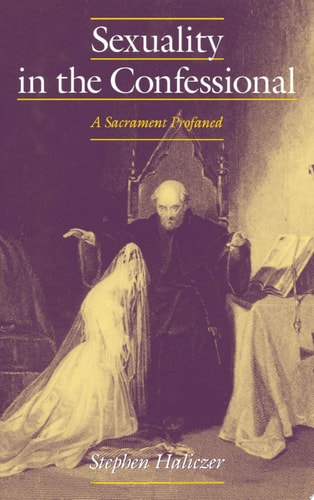
Sexuality in the Confessional: A Sacrament Profaned
0
0
As an Amazon Associate and affiliate partner, Menrva Books earns from qualifying purchases. Learn more
Author Description
In Sexuality in the Confessional: A Sacrament Profaned, Stephen Haliczer places the current debate on sex, celibacy, and the Catholic Church in a historical context by drawing upon a wealth of actual case studies and trial evidence to document how, from 1530 to 1819, sexual transgression attended the heightened significance of the Sacrament of Penance.Attempting to reassert its moral and social control over the faithful, the Counter-Reformation Church underscored the importance of communion and confession. Priests were asked to be both exemplars of celibacy and "doctors of souls," and the Spanish Inquisition was there to punish transgressors.Haliczer relates the stories of these priests as well as their penitents, using the evidence left by Inquisition trials to vividly depict sexual misconduct, during and after confession, and the punishments wayward priests were forced to undergo. In the process, he sheds new light on the Church of the period, the repressed lives of priests, and the lives of their congregations; coming to a conclusion as startling as it is timely.Based on an exhaustive investigation of Inquisition cases involving soliciting confessors as well as numerous confessors' manuals and other works, Sexuality in the Confessional makes a significant contribution to the history of sexuality, women's history, and the sociology of religion.
Menrva's Summary
THE THESIS
This work investigates the intersection of clerical celibacy, the Sacrament of Penance, and sexual misconduct within the Spanish Catholic Church between 1530 and 1819. Stephen Haliczer, a historian specializing in early modern Spain, utilizes extensive archival records from the Spanish Inquisition to analyze how the Church attempted to enforce moral discipline. By examining trial transcripts and confessional manuals, the author argues that the heightened emphasis on confession during the Counter-Reformation created unique opportunities for sexual transgression, revealing the tension between institutional authority and the lived realities of the clergy and laity.
THE SCOPE MAP
What You Will Find
- Analysis of Inquisition trial records documenting cases of soliciting confessors.
- Examination of the social and psychological pressures of clerical celibacy in early modern Spain.
- Review of historical confessional manuals and theological guidelines for priests.
- Investigation into the power dynamics between priests and their penitents within the confessional space.
THE AUTHORITY PERSPECTIVE
Scholars recognize this text as a significant contribution to the history of sexuality and the sociology of religion for its rigorous use of primary source evidence. Readers frequently note the academic density of the prose, which provides a detailed look at the institutional mechanisms of the Spanish Inquisition.
Page Count:
280
Publication Date:
1996-01-25
Publisher:
Oxford University Press
ISBN-10:
0195096568
ISBN-13:
9780195096569
History
Religion
Gender Studies
European History
Catholic Church
Catholicism
Sociology
Confession