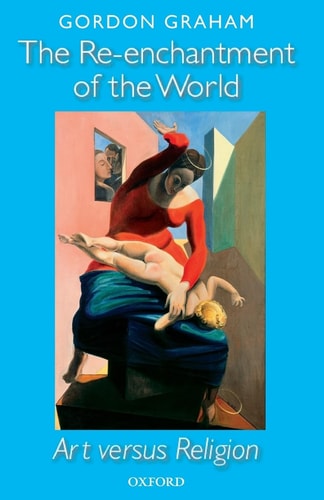
The Re-enchantment of the World: Art versus Religion
0
0
As an Amazon Associate and affiliate partner, Menrva Books earns from qualifying purchases. Learn more
Author Description
The Re-enchantment of the World is a philosophical exploration of the role of art and religion as sources of meaning in an increasingly material world dominated by science. Gordon Graham takes as his starting point Max Weber's idea that contemporary Western culture is marked by a 'disenchantment of the world' -- the loss of spiritual value in the wake of religion's decline and the triumph of the physical and biological sciences. Relating themes in Hegel, Nietzsche, Schleiermacher, Schopenhauer, and Gadamer to topics in contemporary philosophy of the arts, Graham explores the idea that art, now freed from its previous service to religion, has the potential to re-enchant the world. In so doing, he develops an argument that draws on the strengths of both 'analytical' and 'continental' traditions of philosophical reflection.The opening chapter examines ways in which human lives can be made meaningful as a background to the debates surrounding secularization and secularism. Subsequent chapters are devoted to painting, literature, music, architecture, and festival with special attention given to Surrealism, 19th-century fiction, James Joyce, the music of J. S. Bach and the operas of Wagner. Graham concludes that that only religion properly so called can 'enchant the world', and that modern art's ambition to do so fails.
Menrva's Summary
THE THESIS
Can art effectively replace religion as a source of spiritual meaning in a secular, scientifically-dominated society? Gordon Graham, a philosopher specializing in aesthetics and the philosophy of religion, examines the Weberian concept of 'disenchantment' to determine if artistic expression possesses the capacity to restore spiritual value to the modern world. By synthesizing analytical and continental philosophical frameworks, Graham evaluates whether the autonomy of modern art allows it to function as a substitute for traditional religious structures.
THE SCOPE MAP
What You Will Find
- A critical analysis of secularization theories derived from Max Weber and 19th-century German philosophy.
- Comparative studies of painting, literature, music, and architecture as potential vehicles for spiritual meaning.
- Philosophical investigations into the works of James Joyce, J. S. Bach, and Richard Wagner.
- A concluding argument regarding the limitations of aesthetic experience in providing the depth of traditional religious belief.
THE AUTHORITY PERSPECTIVE
Scholars and students of aesthetics frequently cite this work for its balanced integration of disparate philosophical traditions. Readers often note the density of the prose, which requires a foundational understanding of the thinkers mentioned to fully grasp the author's nuanced conclusions.
Page Count:
224
Publication Date:
2010-04-19
Publisher:
Oxford University Press
ISBN-10:
0199581371
ISBN-13:
9780199581375
Philosophy
Religion
Aesthetics
Art History
Art
Religion
Community Tags
Similar Books