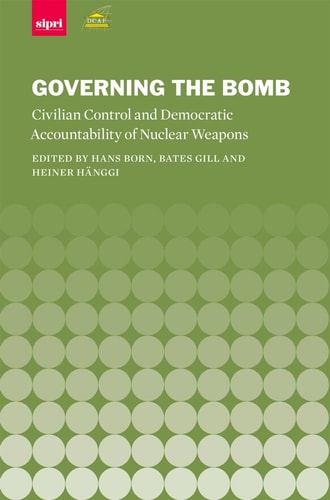
Governing the Bomb: Civilian Control and Democratic Accountability of Nuclear Weapons
0
0
As an Amazon Associate and affiliate partner, Menrva Books earns from qualifying purchases. Learn more
Author Description
'Go nuclear' or 'go zero'--as the international community stands at a nuclear crossroads, a number of questions demand urgent attention: How do established and emerging nuclear-armed states manage their nuclear affairs? Who commands and controls a country's nuclear forces? What effect does the balance between secrecy and openness have on larger questions of security and democracy?Governing Nuclear Weapons is grounded in the belief that the public's ability to hold nuclear-armed states accountable for the security of their weapons is contingent on proper knowledge of domestic nuclear governance. With a special emphasis on civilian control and democratic accountability, it seeks to illuminate the structures and processes of nuclear weapons governance of eight nuclear-armed states: China, France, Russia, the UK, and the US, as well as India, Israel, and Pakistan.It examines the theoretical as well as practical functions and structures of those who possess the power to make nuclear decisions and those who have the practical means and physical opportunity to execute those decisions. While the book assesses the whole spectrum of political oversight and control mechanisms in operation for each country--including the roles and requirements of the executive, the military and specialized civilian institutions--it also takes a closer look at parliamentary institutions and civil society at large.As nuclear terrorism, proliferation and disarmament vie for the top slot on the global security agenda, a comparative understanding of the various national nuclear discourses is no longer optional, but required.
Menrva's Summary
THE THESIS
This monograph investigates the critical tension between national security secrecy and the necessity of democratic accountability in the governance of nuclear-armed states. The authors, representing the Geneva Centre for the Democratic Control of Armed Forces and the Stockholm International Peace Research Institute, provide a comparative analysis of how eight nuclear-armed nations manage their arsenals. By examining the interplay between executive authority, military command, and civilian oversight, the text argues that public knowledge of nuclear governance is a prerequisite for responsible state behavior in the modern era.
THE SCOPE MAP
What You Will Find
- Comparative analysis of nuclear governance structures in China, France, Russia, the UK, the US, India, Israel, and Pakistan.
- Examination of the roles played by executive branches, military command structures, and parliamentary institutions.
- Assessment of the balance between operational secrecy and the requirements of democratic transparency.
- Evaluation of the influence of civil society on national nuclear policy and security discourse.
THE AUTHORITY PERSPECTIVE
Experts identify this work as a foundational comparative study for scholars of international security and democratic governance. Readers frequently note the academic density of the prose, which serves as a comprehensive reference for understanding the institutional mechanisms behind global nuclear policy.
Page Count:
264
Publication Date:
2010-12-09
Publisher:
Oxford University Press
ISBN-10:
0199589909
ISBN-13:
9780199589906
International relations
Military History
Government
Security Studies
Civil-military relations
Arms Control
Nuclear weapons
Community Tags
Similar Books











Reader Comments
Share Your Thoughts
No comments yet. Be the first to share your thoughts!