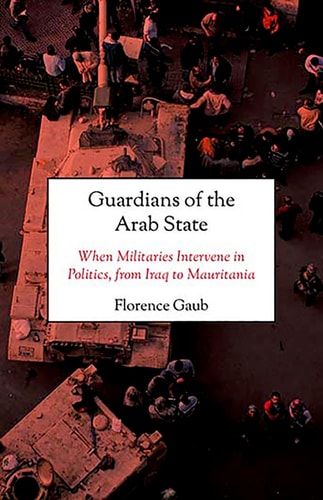
Guardians of the Arab State: When Militaries Intervene in Politics, from Iraq to Mauritania
0
0
As an Amazon Associate and affiliate partner, Menrva Books earns from qualifying purchases. Learn more
Author Description
Guardians of the Arab State explains clearly and concisely how and why military organizations become involved in politics across the Middle East and North Africa, identifying four key factors: a high degree of organizational capacity, clear institutional interest, a forgiving population and weak civilian control.Looking at numerous case studies ranging from Mauritania to Iraq, the book finds that these factors are common to all Arab countries to have experienced coups in the last century. It also finds that the opposite is true in cases like Jordan, where strong civilian control and the absence of capacity, interest, or a positive public image made coup attempts futile. Gaub also convincingly argues that the reasons are structural rather than cultural, thereby proving a counter-narrative to conventional explanations, which look at Arab coups along religious or historical lines. In essence, the questions addressed herein lead back to issues of weak statehood, legitimacy, and resource constraints - all problems the Arab world has struggled with since independence. Guardians of the Arab State picks up where previous literature on Middle Eastern military forces dropped the debate, and provides an updated and insightful analysis into the soul of Arab armies.
Menrva's Summary
THE THESIS
This book investigates the structural conditions that drive military intervention in politics across the Middle East and North Africa. Florence Gaub, a senior analyst with extensive expertise in regional security, utilizes a comparative political framework to analyze why certain Arab militaries seize power while others remain subordinate to civilian authority. Her argument shifts the focus from cultural or religious explanations toward institutional capacity, organizational interest, and the presence of weak civilian oversight.
THE SCOPE MAP
What You Will Find
- A comparative analysis of military intervention across diverse Arab nations including Iraq and Mauritania.
- A four-factor framework identifying organizational capacity, institutional interest, public perception, and civilian control.
- Empirical evidence drawn from historical case studies of successful and failed coup attempts.
Scope Limits
- The analysis focuses primarily on structural and institutional variables rather than individual personality-driven leadership studies.
- The text does not provide an exhaustive history of every military engagement in the region, but rather focuses on the mechanics of political intervention.
THE AUTHORITY PERSPECTIVE
Experts recognize this work as a significant contribution to the study of civil-military relations in the Arab world, particularly for its rejection of essentialist cultural arguments. Readers frequently note the clarity of the author's structural framework, which makes the complex political dynamics of the region accessible to both students and policy practitioners.
Page Count:
224
Publication Date:
2017-09-01
Publisher:
Oxford University Press
ISBN-10:
019069761X
ISBN-13:
9780190697617
Civil-military relations
Middle Eastern
Government
Middle East
International relations
Military History
Community Tags
Similar Books