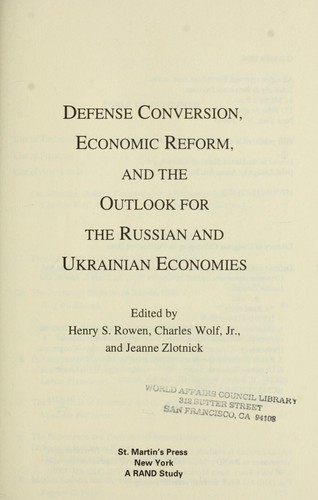
Defense Conversion, Economic Reform, and the Outlook for the Russian and Ukrainian Economies
0
0
As an Amazon Associate and affiliate partner, Menrva Books earns from qualifying purchases. Learn more
Author Description
Russia and Ukraine are struggling to change over from command to market economies. Both are heirs to protectionist policies that for years supported the weight of a mammoth military-industrial complex. This book investigates the defense sector's key role in the economies of these two countries, its fate in relation to political changes, and its impact on those same changes. What sets this book apart from other analyses is that the contributors are mostly Russians and Ukrainians, rather than Westerners. As respected officials from government, the military, and the scholarly community, the contributors have first-hand knowledge of economic life in their respective countries. The reader will discover more dissent than consensus among the authors in their debates of Russian and Ukrainian economic policy and security issues. However, above the din of argument, the editors promote a stance of "limited optimism" toward the economies of the two republics. Although signs of poor economic health are evident, the gloomy forecasts made by some analysts today may be biased by overly optimistic accounts from the past and by data that fails to consider recent gains in the private sector.
Menrva's Summary
THE THESIS
This book examines the complex transition from command to market economies in Russia and Ukraine, focusing on the critical role of their defense sectors. The contributors, primarily Russian and Ukrainian officials and scholars, offer firsthand insights into the economic and political challenges of post-Soviet reform. The book investigates the impact of the military-industrial complex on economic policy and political change, exploring the debates and differing perspectives among the authors on economic policy and security issues.
THE SCOPE MAP
- Analysis of defense conversion and economic reform in Russia and Ukraine.
- The role of the military-industrial complex in the economies of both nations.
- Impact of political changes on the defense sector and vice versa.
- First-hand accounts from Russian and Ukrainian government, military, and scholarly officials.
- Debates and differing viewpoints on economic policy and security issues.
- Assessment of the outlook for the Russian and Ukrainian economies.
- Consideration of private sector gains and potential biases in economic forecasting.
THE AUTHORITY PERSPECTIVE
The book presents a nuanced view of the economic transitions in Russia and Ukraine, with contributors offering diverse perspectives from within their respective countries. The collection highlights internal debates among experts regarding economic policy and security, suggesting a dynamic and contested reform process. Despite evident economic challenges, the editors advocate for a stance of 'limited optimism,' cautioning against overly pessimistic forecasts that may overlook recent private sector advancements. This approach aims to provide a more balanced understanding of the complex economic landscape.
Page Count:
262
Publication Date:
1994-01-01
ISBN-10:
031212158X
ISBN-13:
9780312121587
Politics
Non-Fiction
History
Economics
Community Tags
Similar Books