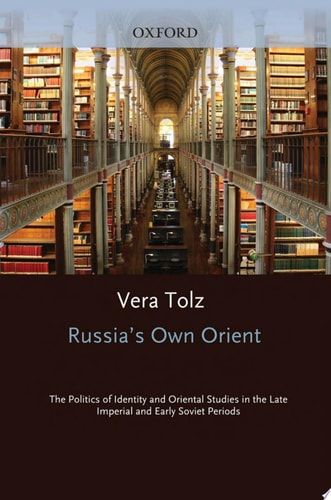
Russia's Own Orient: The Politics of Identity and Oriental Studies in the Late Imperial and Early Soviet Periods
0
0
As an Amazon Associate and affiliate partner, Menrva Books earns from qualifying purchases. Learn more
Author Description
Russia's own Orient examines how intellectuals in early twentieth-century Russia offered a new and radical critique of the ways in which Oriental cultures were understood at the time. Out of the ferment of revolution and war, a group of scholars in St. Petersburg articulated fresh ideas about the relationship between power and knowledge, and about Europe and Asia as mere political and cultural constructs. Their ideas anticipated the work of Edward Said and post-colonial scholarship by half a century. The similarities between the two groups were, in fact, genealogical. Said was indebted, via Arab intellectuals of the 1960s who studied in the Soviet Union, to the revisionist ideas of Russian Orientologists of the fin de siecle.But why did this body of Russian scholarship of the early twentieth century turn out to be so innovative? Should we agree with a popular claim of the Russian elites about their country's particular affinity with the 'Orient'? There is no single answer to this question. The early twentieth century was a period when all over Europe a fascination with things 'Oriental' engendered the questioning of many nineteenth-century assumptions and prejudices. In that sense, the revisionism of Russian Orientologists was part of a pan-European trend. And yet, Tolz also argues that a set of political, social, and cultural factors, which were specific to Russia, allowed its imperial scholars to engage in an unusual dialogue with representatives of the empire's non-European minorities. It is together that they were able to articulate a powerful long-lasting critique of modern imperialism and colonialism, and to shape ethnic politics in Russia across the divide of the 1917 revolutions.
Menrva's Summary
THE THESIS
This book investigates how early twentieth-century Russian intellectuals challenged prevailing European perceptions of Oriental cultures and the relationship between imperial power and academic knowledge. Vera Tolz, a scholar specializing in Russian history and culture, utilizes archival research and historical analysis to demonstrate how Russian Orientologists anticipated post-colonial critiques decades before they became mainstream in Western academia. She argues that while these scholars participated in a broader European trend of questioning nineteenth-century prejudices, their unique position within the Russian Empire allowed for a distinct, collaborative dialogue with non-European minorities that shaped ethnic politics across the 1917 revolutionary divide.
THE SCOPE MAP
What You Will Find
- Analysis of the intellectual climate in St. Petersburg during the late Imperial and early Soviet periods.
- Examination of the genealogical links between Russian revisionist scholarship and later post-colonial theory, including the work of Edward Said.
- Investigation into the specific political, social, and cultural factors that fostered collaboration between Russian scholars and minority intellectuals.
- Discussion of how these academic developments influenced the evolution of ethnic politics and anti-imperialist thought in Russia.
THE AUTHORITY PERSPECTIVE
Experts recognize this work as a significant contribution to the history of ideas, particularly for its ability to bridge the gap between Russian studies and global post-colonial discourse. Readers frequently note the academic density of the prose, which provides a rigorous examination of how imperial scholarship functions within shifting political landscapes.
Page Count:
224
Publication Date:
2011-04-08
Publisher:
Oxford University Press
ISBN-10:
0199594449
ISBN-13:
9780199594443
History
Russian History
East and West
Intellectual History
Study & Teaching
European History
Community Tags
Similar Books