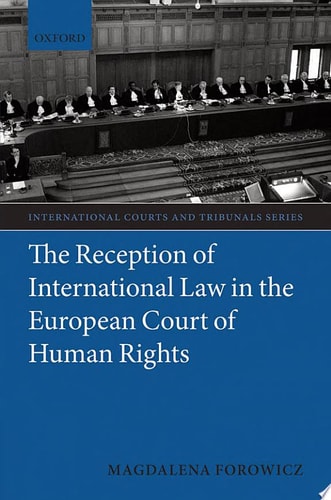
The Reception of International Law in the European Court of Human Rights
0
0
As an Amazon Associate and affiliate partner, Menrva Books earns from qualifying purchases. Learn more
Author Description
The growing number of international courts and tribunals and their bourgeoning case law have fuelled concerns about the fragmentation of international law. This arises as a consequence of both the specialized regimes these courts create and the multiple ways in which they may interpret international law emanating from other sources.This book considers this issue by examining the busiest and arguably most successful international court, the European Court of Human Rights. More specifically, it focuses on the jurisprudence of the Court and its predecessor, the European Commission of Human Rights, covering a range of special human rights regimes, treaty law, and the case law of the International Court of Justice.The author assesses whether the Court has been able to adopt a coherent, comprehensive approach to the interpretation and evaluation of international law and thus the extent to which it has been able to contribute to the development and coherence of international law.
Menrva's Summary
THE THESIS
This book investigates whether the European Court of Human Rights maintains a coherent approach to interpreting international law amidst the growing fragmentation of global legal regimes. Magdalena M. Forowicz, a legal scholar, utilizes an extensive analysis of the jurisprudence produced by the European Court of Human Rights and its predecessor, the European Commission of Human Rights. The work evaluates how these bodies integrate external international legal sources, such as treaty law and the case law of the International Court of Justice, into their own human rights framework. The primary argument centers on the Court's capacity to act as a stabilizing force for coherence within the broader international legal order.
THE SCOPE MAP
What You Will Find
- Analysis of the jurisprudence of the European Court of Human Rights and the European Commission of Human Rights
- Examination of the interaction between specialized human rights regimes and general international law
- Evaluation of the Court's interpretation of treaty law and International Court of Justice precedents
- Assessment of the risks of legal fragmentation in international judicial systems
THE AUTHORITY PERSPECTIVE
Legal scholars and practitioners frequently cite this work as a rigorous examination of the intersection between regional human rights protections and global international law. Experts highlight the book's utility for understanding the technical challenges of judicial consistency in an increasingly fragmented legal landscape.
Page Count:
456
Publication Date:
2010-11-05
Publisher:
Oxford University Press
ISBN-10:
0199592675
ISBN-13:
9780199592678
Human rights
International Law
Jurisprudence
Courts_europe
European Law
Law
Community Tags
Similar Books