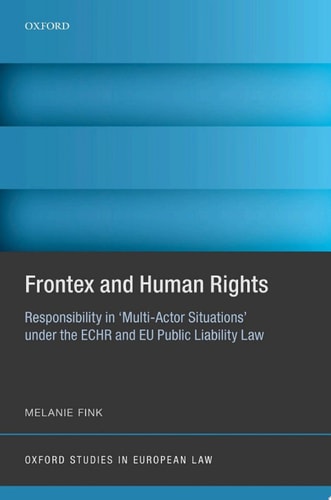
Frontex and Human Rights: Responsibility in 'Multi-Actor Situations' under the ECHR and EU Public Liability Law
0
0
As an Amazon Associate and affiliate partner, Menrva Books earns from qualifying purchases. Learn more
Author Description
This book analyses the allocation of responsibility for human rights violations that occur in the context of border control or return operations coordinated by Frontex. The analysis is conducted in three parts. The first part examines the detailed roles and powers of Frontex and the states involved during joint operations, focussing on the decision-making processes and chains of command. The second and third parts develop general rules that govern the allocation of responsibility under public international law, ECHR law, and EU non-contractual liability law in order to apply them to Frontex operations. To illustrate the practical implications of the findings, the study uses four hypothetical scenarios that are based on situations that have in the past given rise to human rights concerns. The book concludes that whilst responsibility for most human rights violations lies with the host state of an operation, it often shares this responsibility with participating states who contribute large assets as well as Frontex. However, the book also exposes how difficult it is for individuals to find a place for bringing complaints against violations of their human rights suffered at the EU's external borders. This casts doubts on whether the current legal framework offers them an effective remedy.
Menrva's Summary
THE THESIS
This book investigates the complex allocation of legal responsibility for human rights violations occurring during border control and return operations coordinated by Frontex. Melanie Fink, a legal scholar, utilizes a rigorous analysis of public international law, the European Convention on Human Rights (ECHR), and EU non-contractual liability law to address the accountability gap in multi-actor operations. By examining decision-making processes and chains of command, the author constructs a framework to determine which entities—host states, participating states, or the agency itself—bear liability for rights infringements.
THE SCOPE MAP
What You Will Find
- Analysis of Frontex operational roles, powers, and command structures
- Legal frameworks for responsibility under ECHR and EU public liability law
- Four hypothetical scenarios modeling real-world human rights concerns
- Evaluation of access to justice and effective remedies for individuals
Scope Limits
- Does not provide a comprehensive history of all Frontex operations
- Does not offer a political critique of border policy beyond legal liability
THE AUTHORITY PERSPECTIVE
Legal scholars and practitioners identify this work as a foundational text for understanding the intersection of EU agency operations and human rights obligations. Readers frequently note the academic density of the prose, which is tailored for experts in European law and international human rights litigation.
Page Count:
405
Publication Date:
2018-01-01
Publisher:
OUP Oxford
ISBN-10:
0192572377
ISBN-13:
9780192572370
International Law
European Law
Public Liability
European Union
Professional Career & Trade
Human rights
Law
Community Tags
Similar Books