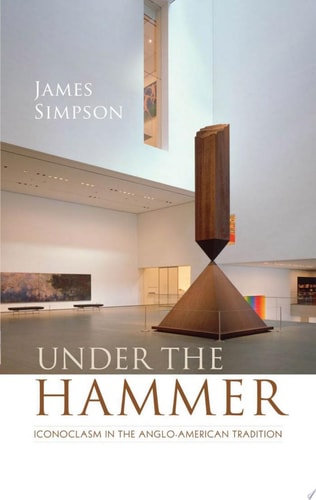
Under the Hammer: Iconoclasm in the Anglo-American Tradition
0
0
As an Amazon Associate and affiliate partner, Menrva Books earns from qualifying purchases. Learn more
Author Description
When we think of breaking images, we assume that it happens somewhere else. We also tend to think of iconoclasts as barbaric. Iconoclasts are people like the Taliban, who blew up Buddhist statues in 2001. We tend, that is, to look with horror on iconoclasm.This book argues instead that iconoclasm is a central strand of Anglo-American modernity. Our horror at the destruction of art derives in part from the fact that we too did, and still do, that. This is most obviously true of England's iconoclastic century between 1538 and 1643. That century of legislated early modern image breaking, exceptional in Europe for its jurisdictional extension and duration, stands at the core of this book. That's when written texts, especially poems, rather than visual images became our living monuments.Surely, though, the story of image breaking stops in the eighteenth century, with its enlightened cultivation of the visual arts and the art market. Not so, argues Under the Hammer: once started, iconoclasm is difficult to stop. It ripples through cultures, into the psyche, and it ripples through history. Museums may have protected images from the iconoclast's hammer, but also subject images to metaphorical iconoclasm. Aesthetics may have drawn a protective circle around the image, but as it did so, it also neutralised the image.The ripple effect also continues across the Atlantic, into puritan culture, into twentieth-century American Abstract Expressionism, and into the puritan temple of modern art. That, in fact, is where this book starts, with mid-twentieth-century abstract painting: the image has survived, just, but it bears the scars of a 500 year history.
Menrva's Summary
THE THESIS
This book investigates the argument that iconoclasm is not a barbaric anomaly, but a foundational and ongoing component of Anglo-American modernity. James Simpson, a professor of English literature, utilizes historical analysis and cultural theory to demonstrate how the systematic destruction of images in early modern England established a lasting pattern of image-breaking that persists in contemporary aesthetics and American art. By tracing this trajectory from the sixteenth century to the present, the author challenges the assumption that iconoclasm is a foreign or historical relic, positioning it instead as a central mechanism of Western cultural development.
THE SCOPE MAP
What You Will Find
- A detailed examination of the English iconoclastic period between 1538 and 1643.
- An analysis of the transition from visual monuments to textual and poetic authority.
- A study of the metaphorical iconoclasm inherent in modern museum practices and aesthetic theory.
- An exploration of the influence of Puritan culture on twentieth-century American Abstract Expressionism.
THE AUTHORITY PERSPECTIVE
Scholars and critics frequently cite this work as a sophisticated re-evaluation of the relationship between art, religion, and modern identity. Readers often note the academic density of the prose, which demands a high level of engagement with historical and philosophical concepts.
Page Count:
204
Publication Date:
2011-02-01
Publisher:
Oxford University Press
ISBN-10:
0199591652
ISBN-13:
9780199591657
History
Religion
English
Modernism aesthetics
Art British
Iconoclasm
English & College Success
Literary Criticism
Art History