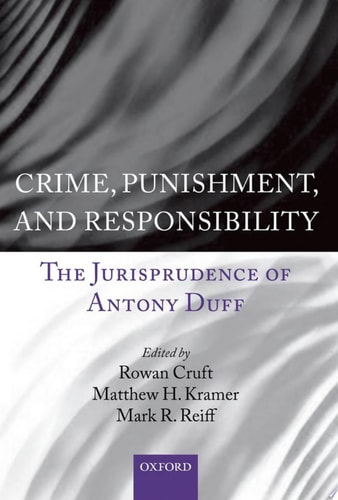
Crime, Punishment, and Responsibility: The Jurisprudence of Antony Duff
0
0
As an Amazon Associate and affiliate partner, Menrva Books earns from qualifying purchases. Learn more
Author Description
For many years, Antony Duff has been one of the world's foremost philosophers of criminal law. This volume collects essays by leading criminal law theorists to explore the principal themes in his work. In a response to the essays, Duff clarifies and develops his position on central problems in criminal law theory.Some of the essays concentrate on the topic of criminalization. That is, they examine what forms of conduct (including attempts, offensiveness, and negligence) can aptly qualify as criminal offences, and what principled limits, if any, should be placed on the reach of the criminal law. Several of the other essays assess the thesis that punishment is justifiable as a form of communication between offenders and their community. Those essays examine the presuppositions (about the nature and function of community, and about the moral structure of atonement) that must be embraced if communication is to be a primary role for punishment. The remaining essays examine the nature and limits of responsibility in the law, as they engage with philosophical debates over 'moral luck' by investigating the ways in which the law can legitimately hold people responsible for events that were not within their control. These chapters tie the first and third parts of the book together, as they explore the relationship between the principles that determine a person's responsibility and the principles that determine which types of actions can appropriately be criminalized.Finally, Duff responds with comments that seek to defend and clarify his views while also acknowledging the correctness of some of the critics' objections.
Menrva's Summary
THE THESIS
This volume investigates the foundational principles of criminal law theory as articulated by Antony Duff, specifically focusing on the moral justifications for criminalization, punishment, and legal responsibility. The authors, including Rowan Cruft and Matthew H. Kramer, compile a series of scholarly essays that critique and expand upon Duff's communicative theory of punishment. By engaging with these diverse perspectives, the text seeks to reconcile the moral structure of atonement with the practical application of criminal statutes in a modern legal framework.
THE SCOPE MAP
What You Will Find
- Analysis of criminalization criteria including attempts, offensiveness, and negligence.
- Examination of punishment as a communicative process between offenders and the community.
- Philosophical inquiry into moral luck and the limits of legal responsibility.
- A concluding response from Antony Duff addressing specific critiques and refining his theoretical positions.
THE AUTHORITY PERSPECTIVE
Legal scholars and philosophers identify this collection as a critical resource for understanding contemporary debates in criminal jurisprudence. Readers frequently note the academic density of the prose, which is intended for an audience already familiar with the nuances of legal theory and moral philosophy.
Page Count:
430
Publication Date:
2011-09-15
Publisher:
Oxford University Press
ISBN-10:
0199592810
ISBN-13:
9780199592814
Philosophy
Ethics
Law
Jurisprudence
Criminal Law
Community Tags
Similar Books