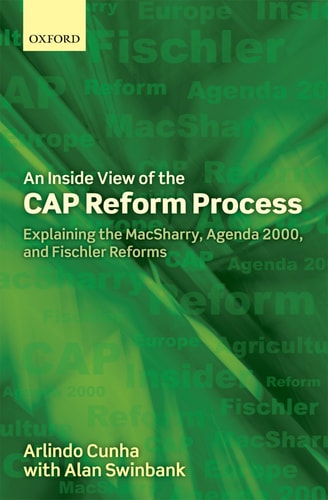
An Inside View of the CAP Reform Process: Explaining the MacSharry, Agenda 2000, and Fischler Reforms
0
0
As an Amazon Associate and affiliate partner, Menrva Books earns from qualifying purchases. Learn more
Author Description
An Inside View of the CAP Reform Process is about EU decision-making, in particular for the EU's Common Agricultural Policy (CAP). From its formation in the 1960s through to 1992 the CAP was almost immune to change; but from 1992 a series of major reforms took place. Many authors have asked why and how this change came about, including academics writing from political economy and political science traditions, and EU officials themselves. With the benefit of Arlindo Cunha's intimate insider's knowledge, this book delves into the mysteries of the policy making process by assessing the MacSharry, Agenda 2000, and Fischler reforms, explaining how, and why, CAP reform became part of the political agenda, and the decisions that were taken. It focuses in particular on the role of the Commission and the Commissioner for Agriculture, the Council of Ministers and its Presidency, and the European Parliament. Drawing upon the economics and political science literatures as appropriate, the book adopts a heuristic political economy approach.The MacSharry reform was much influenced by the Uruguay Round of GATT negotiations, and the 2003 Fischler reform by the Doha Round of WTO negotiations. A Delphi survey of key decision-makers, assessing their perception of the drivers of policy reform, and an analysis of subsequent CAP reform, including the Health Check in 2008 and preparations for the post-2013 CAP review, round-off the discussion. The former EU Commissioner for Agriculture and Rural Development, Franz Fischler, contributes a Foreword.
Menrva's Summary
THE THESIS
This book investigates the mechanisms of EU decision-making by analyzing the political and economic drivers behind the Common Agricultural Policy (CAP) reforms from 1992 to the post-2013 period. Alan Swinbank and Arlindo Cunha utilize a political economy framework to examine how institutional actors, including the European Commission, the Council of Ministers, and the European Parliament, navigated complex policy shifts. By combining academic theory with Cunha’s firsthand experience as an insider, the authors provide a comprehensive assessment of the pressures that transformed a historically static policy into one characterized by frequent reform.
THE SCOPE MAP
What You Will Find
- Detailed analysis of the MacSharry, Agenda 2000, and Fischler reform cycles.
- Examination of the influence of international trade negotiations, specifically GATT and WTO, on domestic agricultural policy.
- A Delphi survey methodology used to capture the perceptions of key decision-makers regarding policy drivers.
- Assessment of the institutional roles played by the Commissioner for Agriculture and the Council Presidency.
THE AUTHORITY PERSPECTIVE
Experts identify this work as a significant contribution to the study of European institutional history and agricultural policy. Readers frequently note the academic density of the prose, which serves as a foundational text for those studying the evolution of EU governance.
Page Count:
256
Publication Date:
2011-04-01
Publisher:
Oxford University Press
ISBN-10:
0199591571
ISBN-13:
9780199591572
Economics
History
Public Policy
Agriculture
European Union
Community Tags
Similar Books