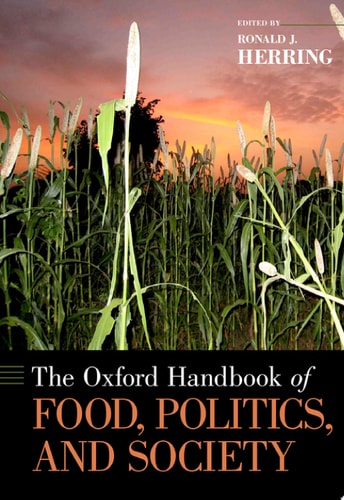
The Oxford Handbook of Food, Politics, and Society
0
0
As an Amazon Associate and affiliate partner, Menrva Books earns from qualifying purchases. Learn more
Author Description
Food has, for most of our species history, been intensely political: who gets to eat what, how often, and through what means? The scale of polity in question has shifted over time, from very local institutions dividing up grain piles to an international community imagined in the Millennium Development Goals of the United Nations. Simultaneously, the numbers and interests of people asserting political stakes in food and agriculture have likewise shifted up and out. Global networks advocate social justice in distal agrarian systems, promotion of some farming techniques and prohibition of others, food sovereignty or efficiencies of markets and trade. Political consumerism allows the well-endowed to "vote with their dollars" for changes in food systems far from home, but depends on certification and labeling from unseen institutions. As an object of governmentality, food has never been so prominent.The thirty-five handbook chapters confront four major themes in the politics of food: property, technology, justice and knowledge. Ronald Herring's editorial introduction asks how food is political, highlighting contention around the role of market, state and information in societal decisions. The first section of the handbook then examines technology, science and knowledge in food production. What is known - and disputed - about malnutrition, poverty and food security? The second section addresses ethics, rights and distributive justice: agrarian reform, gender inequality, entitlements and subsidies, and the social vision of the alternative food movement. The third section looks to intersections of agriculture and nature: wild foods, livestock, agro-ecological approaches to sustainability, and climate change and genetic engineering. The fourth section addresses food values and culture: political consumerism, labeling and certification, the science and cultural politics of food safety, values driving regulation of genetically modified foods and potential coexistence of GMOs,
Menrva's Summary
THE THESIS
This volume investigates the complex intersection of food systems, political governance, and societal structures to determine how food functions as a central object of political contention. Editor Ronald J. Herring, a prominent scholar in political science and agrarian studies, curates a collection of thirty-five chapters that analyze the roles of the state, market forces, and information in shaping global food policies. The text provides a comprehensive framework for understanding how food production, distribution, and consumption are inextricably linked to power dynamics and social justice.
THE SCOPE MAP
What You Will Find
- Analysis of four primary thematic pillars: property, technology, justice, and knowledge.
- Examination of the tension between local food sovereignty and global market efficiencies.
- Discussion of the political implications of genetic engineering, climate change, and agro-ecological sustainability.
- Evaluation of political consumerism, labeling, and the regulatory frameworks governing food safety.
Scope Limits
- The text does not provide a practical guide for individual agricultural production or personal dietary management.
- It does not offer a singular, unified policy recommendation but rather presents a spectrum of scholarly perspectives on food politics.
THE AUTHORITY PERSPECTIVE
Scholars and students of political science frequently cite this handbook as a foundational reference for understanding the multifaceted nature of global food systems. Readers often note the academic density of the prose, which is designed for researchers and advanced practitioners in the field of food policy.
Page Count:
904
Publication Date:
2014-01-01
Publisher:
Oxford University Press
ISBN-10:
019022665X
ISBN-13:
9780190226657
Sociology
Public Policy
Food Studies
Agriculture
Cultural Anthropology
Food supply
Community Tags
Other Editions(2)

Similar Books




Reader Comments
Share Your Thoughts
No comments yet. Be the first to share your thoughts!