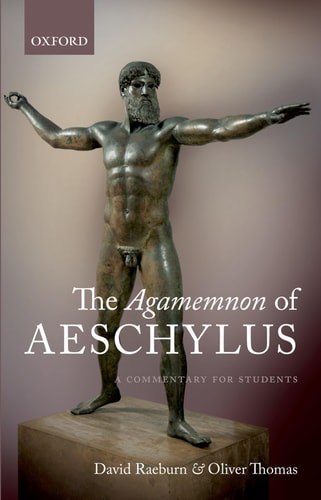
The Agamemnon of Aeschylus: A Commentary for Students
0
0
As an Amazon Associate and affiliate partner, Menrva Books earns from qualifying purchases. Learn more
Author Description
This commentary discusses Aeschylus' play Agamemnon (458 B.C.), which is one of the most popular of the surviving ancient Greek tragedies, and is the first to be published in English since 1958. It is designed particularly to help students who are tackling Aeschylus in the original Greek for the first time, and includes a reprint of D. L. Page's Oxford Classical Text of the play. The introduction defines the place of Agamemnon within the Oresteia trilogy as a whole, and the historical context in which the plays were produced. It discusses Aeschylus' handling of the traditional myth and the main ideas which underpin his overall design: such as the development of justice and the nature of human responsibility; and it emphasizes how the power of words, seen as ominous speech-acts which can determine future events, makes a central contribution to the play's dramatic momentum. Separate sections explore Aeschylus' use of theatrical resources, the role of the chorus, and the solo characters. Finally there is an analysis of Aeschylus' distinctive poetic style and use of imagery, and an outline of the transmission of the play from 458 B.C. to the first printed editions.
Menrva's Summary
THE THESIS
This commentary investigates the linguistic, structural, and thematic complexities of Aeschylus' Agamemnon to provide a foundational resource for students reading the work in its original Greek. David Raeburn, a scholar of classical literature, synthesizes historical context with technical analysis to guide readers through the intricacies of the Oresteia. The text provides a comprehensive framework for understanding how Aeschylus utilizes myth, justice, and the performative power of language to drive dramatic momentum.
THE SCOPE MAP
What You Will Find
- A complete reprint of D. L. Page's Oxford Classical Text of the play.
- Analysis of the play's historical context and its position within the Oresteia trilogy.
- Examination of Aeschylus' poetic style, imagery, and use of ominous speech-acts.
- Technical exploration of theatrical resources, the function of the chorus, and character development.
THE AUTHORITY PERSPECTIVE
Experts recognize this work as a vital pedagogical tool for those engaging with Aeschylus in the original language for the first time. Readers frequently note the clarity of the commentary, which balances academic rigor with accessible explanations of complex Greek syntax and dramatic structure.
Page Count:
289
Publication Date:
2012-01-13
Publisher:
Oxford University Press, U.S.A.
ISBN-10:
0199595615
ISBN-13:
9780199595617
Drama
Literary Criticism
Education
Ancient Greek
Community Tags
Similar Books