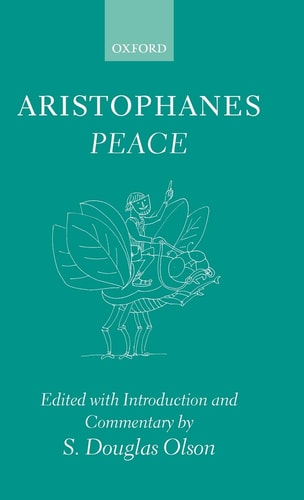
Peace
0
0
As an Amazon Associate and affiliate partner, Menrva Books earns from qualifying purchases. Learn more
Author Description
Aristophanes' Peace was performed at the City Dionysia in Athens in 421 B.C. as a decade-long war with Sparta seemed finally to be drawing to an end, and is one of only eleven extant plays by the greatest Old Comic poet. Olson's edition of the play, which replaces Platnauer's of 1969, is based on a complete new collation of the manuscripts, many of which have never been adequately reported before. The extensive commentary explores matters of all sorts, but it focuses in particular on the realities of daily life in classical Athens and also examines the practical problems of staging. The substantial introduction includes essays on Aristophanes' early career, the politics of the Greek world in the late 420s, and the poet's theology.
Menrva's Summary
THE PULSE
A weary Athenian farmer attempts to end the Peloponnesian War by flying to Olympus on a giant dung beetle to rescue the goddess Peace. Trygaeus, the protagonist, seeks to liberate Peace from the cave where she has been imprisoned by the personification of War. His objective is to restore prosperity to Greece and end the suffering caused by the decade-long conflict with Sparta. The narrative operates within the framework of Old Comedy, utilizing fantastical elements, direct address to the audience, and satirical commentary on contemporary political figures. The physical constraints of the world are suspended by the absurdity of the premise, allowing for a blend of mythological intervention and grounded social critique.
INSIDE THE PAGES
- Use of the 'fantastic voyage' trope to facilitate political satire.
- Incorporation of choral odes that comment on the action and provide thematic depth.
- Frequent breaking of the fourth wall to engage directly with the Athenian audience.
- Satirical characterization of gods and political leaders of the era.
- Use of scatological humor and physical comedy to underscore the absurdity of war.
- Exploration of the contrast between rural agrarian life and urban political strife.
- Integration of mythological figures as allegorical representations of abstract concepts.
- Structural reliance on the traditional agon, or formal debate, between opposing viewpoints.
THE COLLECTIVE ECHO
Readers and critics frequently highlight the play as a significant example of Aristophanic satire that balances bawdy humor with serious political commentary. Discussion often centers on the effectiveness of the play's fantastical elements in critiquing the ongoing Peloponnesian War. Scholars note that the work provides a unique window into the anxieties and hopes of the Athenian citizenry during a period of intense conflict. The pacing is often described as energetic, driven by the protagonist's rapid transitions between the human and divine realms. Many analyses focus on how the play uses the restoration of Peace as a vehicle to address the practical and moral failures of the Greek leadership at the time.
Page Count:
408
Publication Date:
1999-02-25
Publisher:
Clarendon Press
ISBN-10:
0198140819
ISBN-13:
9780198140818
Drama
History
Comedy
Dramatic works
Classical
Ancient Greek
Community Tags
Other Editions(13)

Creative Media Partners, LLC
2025
Default edition
Independently Published
2019

Independently Published
2019

CreateSpace Independent Publishing Platform
2018

Simon & Schuster
2012
CreateSpace Independent Publishing Platform
2011

CreateSpace Independent Publishing Platform
2011
CreateSpace Independent Publishing Platform
2011

CreateSpace Independent Publishing Platform
2010
General Books LLC
2010
Digireads.com Publishing
2004
Clarendon Press
1999
1985
Similar Books

Reader Comments
Share Your Thoughts
No comments yet. Be the first to share your thoughts!