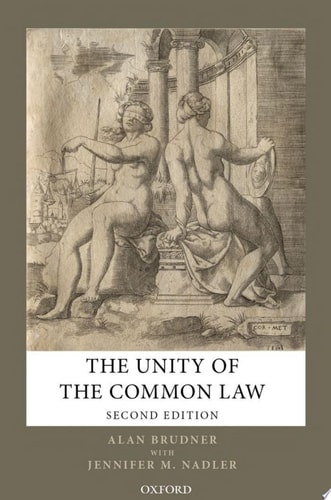
The Unity of the Common Law
0
0
As an Amazon Associate and affiliate partner, Menrva Books earns from qualifying purchases. Learn more
Author Description
In this classic study, Alan Brudner investigates the basic structure of the common law of transactions. For decades, that structure has been the subject of intense debate between formalists, who say that transactional law is a private law for interacting parties, and functionalists, who say that it is a public law serving the collective ends of society. Against both camps, Brudner proposes a synthesis of formalism and functionalism in which private law is modified by a common good without being subservient to it. Drawing on Hegel's legal philosophy, the author exhibits this synthesis in each of transactional law's main divisions: property, contract, unjust enrichment, and tort. Each is a whole composed of private-law and public-law parts that complement each other, and the idea connecting the parts to each other is also latently present in each. Moreover, Brudner argues, a single narrative thread connects the divisions of transactional law to each other. Not a row of disconnected fields, transactional law is rather a story about the realization in law of the agent's claim to be a dignified end-master of its body, its acquisitions, and the shape of its life. Transactional law's divisions are stages in the progress toward that goal, each generating a potential developed by the next. Thus, contract law fulfils what is incompletely realized in property law, negligence law what is germinal in contract law, public insurance what is seminal in negligence law, and transactional law as a whole what is underdeveloped in public insurance. The end point is the limit of what a transactional law can contribute to a life sufficient for dignity.Reconfigured and expanded with a contribution by Jennifer Nadler, The Unity of the Common Law stands out among contemporary theories of private law in that it depicts private law as purposive without being instrumental and as autonomous without being emptily formal.
Menrva's Summary
THE THESIS
This work investigates whether the common law of transactions functions as an autonomous private system or as an instrument of public policy. Alan Brudner, a scholar of legal philosophy, challenges the traditional dichotomy between formalist and functionalist interpretations of law. By utilizing a Hegelian framework, he argues that transactional law represents a coherent, purposive system that balances individual agency with the collective good, presenting the law as a unified narrative of human dignity rather than a collection of disparate rules.
THE SCOPE MAP
What You Will Find
- A comprehensive analysis of the four primary divisions of transactional law: property, contract, unjust enrichment, and tort.
- A philosophical methodology rooted in Hegelian legal theory to reconcile private and public law interests.
- A structural argument that views legal divisions as sequential stages in the realization of individual agency.
- A critical synthesis that positions private law as both autonomous and purposive without succumbing to pure instrumentalism.
THE AUTHORITY PERSPECTIVE
Legal scholars frequently cite this text as a significant contribution to the debate over the nature of private law. Experts highlight the book's dense philosophical rigor and its attempt to provide a unified theory for complex legal doctrines.
Page Count:
384
Publication Date:
2013-12-01
Publisher:
Oxford University Press
ISBN-10:
0199592802
ISBN-13:
9780199592807
Philosophy
Jurisprudence
Common Law
Civil Law
Law Philosophy
Legal Theory
Professional Career & Trade
Law
Community Tags
Other Editions(3)
Similar Books


Reader Comments
Share Your Thoughts
No comments yet. Be the first to share your thoughts!