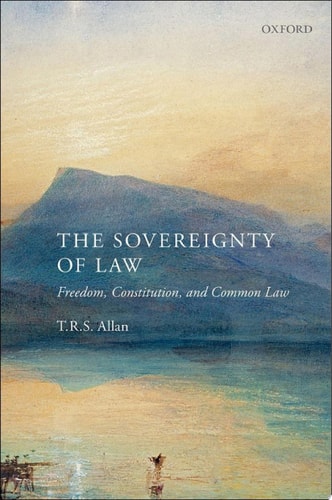
Sovereignty of Law: Freedom, Constitution, and Common Law
0
0
As an Amazon Associate and affiliate partner, Menrva Books earns from qualifying purchases. Learn more
Author Description
In The Sovereignty Of Law, Trevor Allan Presents An Accessible Introduction To His Influential Common Law Constitutional Theory - An Account Of The Unwritten Constitution As A Complex Articulation Of Legal And Moral Principles. The British Constitution Is Conceived As A Coherent Set Of Fundamental Principles Of The Rule Of Law, Legislative Supremacy, And Separation Of Powers. These Principles Combine To Provide An Overarching Unity Of Legality, Legitimacy, And Democracy, Reconciling Political Authority With Individual Freedom. Drawing On The Work Of Lon Fuller And Ronald Dworkin, Allan Emphasizes The Normative Character Of Legal Interpretation - Understanding The Implications Of Statute And Precedent By Reference To Moral Ideals Of Legality And Liberty. Allan Denies That Constitutional Law Can Be Reduced To Empirical Facts About Legislative Or Judicial Conduct Or Opinion. There Is No 'rule Of Recognition' From The Lawyer's Interpretative Viewpoint - Only A Moral Theory Of The Nature And Limits Of Political Authority, Which Lawyers Must Construct In Order To Make Sense Of Legal And Constitutional Practice. A Genuine Republicanism, Protecting Individual Independence, Requires The Safeguards Afforded By Judicial Review, Which Must Ensure That Governmental Action Is Consistent With The Rule Of Law; And The Rule Of Law Encompasses Not Merely The Formal Equality Of All Before The Law, As Enacted Or Declared, But A More Fundamental Idea Of Equal Citizenship. Allan's Interpretative Approach Is Applied To A Wide Range Of Contemporary Issues Of Public Law; His Response To Critics And Commentators Seeks To Deepen The Argument By Exploring The Theoretical Grounds Of These Current Debates And Controversies.
Menrva's Summary
THE THESIS
This book investigates the core question of how the unwritten British constitution reconciles political authority with individual freedom through a framework of legal and moral principles. T. R. S. Allan, a scholar of public law, presents his constitutional theory by synthesizing the works of Lon Fuller and Ronald Dworkin. He argues that constitutional law cannot be reduced to mere empirical facts about legislative or judicial conduct, but must instead be understood as a normative practice rooted in moral ideals of legality and liberty.
THE SCOPE MAP
What You Will Find
- A theoretical framework for the British constitution based on the rule of law, legislative supremacy, and separation of powers.
- An interpretative methodology for understanding statutes and precedents through moral ideals.
- A critique of positivist legal theories that rely on a 'rule of recognition.'
Scope Limits
- The analysis is primarily focused on the British constitutional context rather than comparative international systems.
- The text does not provide a historical survey of constitutional development but focuses on contemporary normative theory.
THE AUTHORITY PERSPECTIVE
Legal scholars and practitioners recognize this work as a significant contribution to contemporary constitutional theory and the interpretation of the rule of law. Readers frequently note the dense, academic nature of the prose, which requires a foundational understanding of jurisprudence to fully grasp the author's arguments.
Page Count:
384
Publication Date:
2013-01-01
Publisher:
Oxford University Press
ISBN-10:
0191508144
ISBN-13:
9780191508141
Règle de droit
Legal Theory
Common Law
Political Philosophy
Rule Of Law
Jurisprudence
Law
Constitutional Law
Community Tags
Similar Books