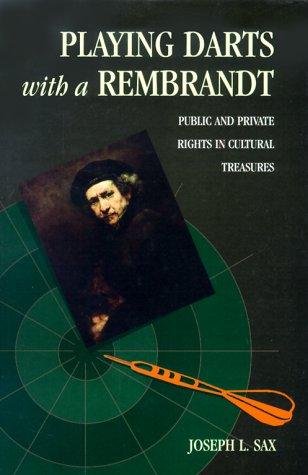
Playing Darts with a Rembrandt
0
0
As an Amazon Associate and affiliate partner, Menrva Books earns from qualifying purchases. Learn more
Author Description
Some of the world's greatest treasures are hidden away and haven't been seen publicly for decades, sometimes for centuries. Others have been destroyed. They are not stolen property. They are simply private property, and no matter their public significance, the public has no claims on them. A capricious owner of Leonardo da Vinci's notebook would be perfectly within his rights to throw it in the fireplace, as James Joyce's grandson did with letters from the author's daughter, or Warren Harding's widow did with her husband's Teapot Dome papers. This is a book about such rights and why they are wrong. Playing Darts with a Rembrandt explores abuses of ownership of cultural treasures in a wide range of settings, including material of historic and scientific interest as well as art and antiquities. It examines the claims made on behalf of the public for preservation, protection, and access to important artifacts, balancing those claims against proprietary and privacy interests, and discusses the proper role of institutions such as museums and libraries that act as repositories. Acknowledging the complexities that sometimes arise (such as the claims of history against the desire of a great figure's family to withhold private letters), in the end it proposes a new species of qualified ownership, to own an object of great public importance is to become a "fortunate, if provisional, trustee, having no right to deprive others who value the objects as much as they do themselves." The fascinating stories that comprise the bulk of the book, ranging from dinosaur excavations and the Dead Sea Scrolls to the fate of presidential papers and the secrets held by the Library of Congress, will be of interest to a wide range of general readers. The extensive discussion of collectors and their role should commend the book to those in the art world, as well as to those professionally associated with museums, libraries, and archives. While written in a readable and untechnical wa
Menrva's Summary
THE THESIS
This book investigates the complex and often contentious issue of ownership rights over cultural treasures, questioning whether private ownership should supersede public claims to preservation, protection, and access. The author, Joseph L. Sax, a legal scholar, examines a wide array of cases involving art, antiquities, historical documents, and scientific artifacts, exploring the tension between private property rights and the public's interest in cultural heritage. The book delves into the ethical considerations of how objects of significant public importance are managed by their owners, proposing a framework for a new form of qualified ownership.
THE SCOPE MAP
- Exploration of private ownership abuses concerning cultural treasures.
- Analysis of claims for public preservation, protection, and access.
- Balancing proprietary and privacy interests against public claims.
- Discussion on the role of institutions like museums and libraries.
- Case studies ranging from dinosaur excavations and the Dead Sea Scrolls to presidential papers and Library of Congress materials.
- Examination of the role of collectors and their impact on cultural heritage.
- Proposal for a new species of qualified ownership for objects of public importance.
THE AUTHORITY PERSPECTIVE
The book is recognized for its accessible and untechnical writing style, making complex legal and ethical issues understandable to a broad audience. Its fascinating stories, drawn from diverse fields such as art, history, and science, are noted for their general reader appeal. The work is particularly recommended for those in the art world and professionals associated with museums, libraries, and archives due to its extensive discussion of collectors and institutional roles. The author's proposed concept of 'fortunate, if provisional, trustee' ownership offers a thought-provoking perspective on balancing private rights with public stewardship of cultural heritage.
Page Count:
245
Publication Date:
1999-01-01
ISBN-10:
0472110446
Philosophy
Art
History
Non-Fiction
Law
Art History
Ethics
Community Tags
Similar Books














