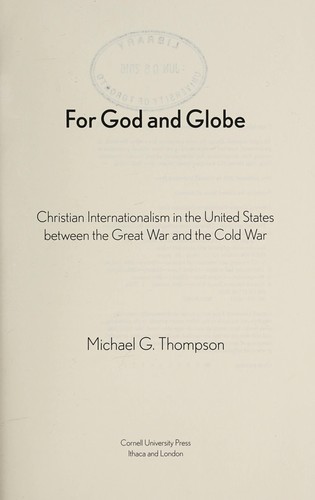
For God and Globe
0
0
As an Amazon Associate and affiliate partner, Menrva Books earns from qualifying purchases. Learn more
Author Description
For God and Globe recovers the history of an important yet largely forgotten intellectual movement in interwar America. Michael G. Thompson explores the way radical-left and ecumenical Protestant internationalists articulated new understandings of the ethics of international relations between the 1920s and the 1940s. Missionary leaders such as Sherwood Eddy and journalists such as Kirby Page, as well as realist theologians including Reinhold Niebuhr, developed new kinds of religious enterprises devoted to producing knowledge on international relations for public consumption. For God and Globe centers on the excavation of two such efforts—the leading left-wing Protestant interwar periodical, The World Tomorrow, and the landmark Oxford 1937 ecumenical world conference. Thompson charts the simultaneous peak and decline of the movement in John Foster Dulles's ambitious efforts to link Christian internationalism to the cause of international organization after World War II. Concerned with far more than foreign policy, Christian internationalists developed critiques of racism, imperialism, and nationalism in world affairs. They rejected exceptionalist frameworks and eschewed the dominant "Christian nation" imaginary as a lens through which to view U.S. foreign relations. In the intellectual history of religion and American foreign relations, Protestantism most commonly appears as an ideological ancillary to expansionism and nationalism. For God and Globe challenges this account by recovering a movement that held Christian universalism to be a check against nationalism rather than a boon to it. -- Provided by publisher.
Menrva's Summary
THE THESIS
This book recovers the history of a significant, yet largely overlooked, intellectual movement in interwar America that re-envisioned the ethics of international relations through a radical-left and ecumenical Protestant lens. Michael G. Thompson examines how missionary leaders, journalists, and theologians developed new religious enterprises focused on producing knowledge about international relations for public consumption. The book centers on two key efforts: the leading left-wing Protestant periodical, The World Tomorrow, and the 1937 ecumenical world conference in Oxford. Thompson traces the movement's rise and fall, particularly in relation to John Foster Dulles's post-World War II attempts to align Christian internationalism with international organization, while also highlighting the movement's critiques of racism, imperialism, and nationalism.
THE SCOPE MAP
- The articulation of new understandings of international relations ethics by radical-left and ecumenical Protestant internationalists.
- The role of key figures such as Sherwood Eddy, Kirby Page, and Reinhold Niebuhr in developing religious enterprises for public knowledge on international relations.
- An in-depth examination of The World Tomorrow periodical and the 1937 Oxford ecumenical world conference.
- Analysis of John Foster Dulles's efforts to link Christian internationalism with international organization after World War II.
- Exploration of Christian internationalists' critiques of racism, imperialism, and nationalism.
- A challenge to the common perception of Protestantism as solely ancillary to American expansionism and nationalism.
- The recovery of a movement that viewed Christian universalism as a check against nationalism.
THE AUTHORITY PERSPECTIVE
The book is recognized for recovering a vital, yet underappreciated, intellectual movement that shaped discussions on international relations in interwar America. It is noted for its detailed examination of key publications and conferences, offering a nuanced perspective on the intersection of religion and foreign policy. The work challenges conventional historical narratives by highlighting a strain of Protestant thought that prioritized universalism over nationalism. This scholarly approach provides a significant contribution to the intellectual history of religion and American foreign relations.
Page Count:
250
Publication Date:
2015-01-01
ISBN-10:
0801452724
ISBN-13:
9780801452727
Religion
Non-Fiction
History
Politics
International relations
Intellectual History
American History
Community Tags
Similar Books














