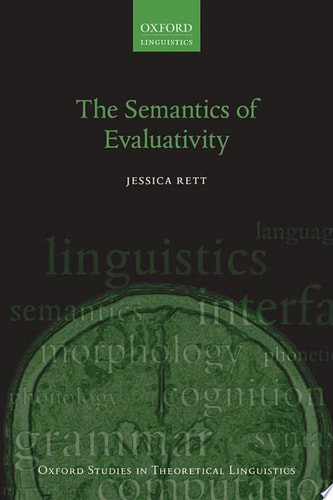
The Semantics of Evaluativity
0
0
As an Amazon Associate and affiliate partner, Menrva Books earns from qualifying purchases. Learn more
Author Description
This book focuses on the semantic phenomenon of evaluativity and its consequences across constructions. Evaluativity has traditionally been associated exclusively with the positive construction, a term for sentences with a gradable adjective but with no overt degree morphology. John is tall is evaluative because it entails that John is tall relative to a contextually valued standard. John is taller than Sue and John is as tall as Sue are not evaluative because both could be used even if John and Sue were short.Previous accounts of evaluativity have assumed that it is not part of the inherent meaning of adjectives, but is contributed by a null morpheme. Jessica Rett argues against this analysis, proposing that no null morpheme is required. Instead, evaluativity is explained on the basis of assumptions that speakers and hearers make about the relationship between the simplicity of a situation and the simplicity of the language used to describe that situation
Menrva's Summary
THE THESIS
This book investigates the semantic origins of evaluativity, challenging the long-standing assumption that it requires a null morpheme. Jessica Rett, a prominent scholar in theoretical linguistics, utilizes formal semantic analysis to re-evaluate how gradable adjectives function within various sentence structures. By examining the relationship between situational complexity and linguistic expression, she proposes a framework that accounts for evaluative meaning without relying on hidden syntactic elements.
THE SCOPE MAP
What You Will Find
- A formal analysis of gradable adjectives and their semantic properties.
- A critique of the null morpheme hypothesis in linguistic theory.
- Comparative studies of positive, comparative, and equative constructions.
- A proposed model linking speaker assumptions to the interpretation of evaluative statements.
THE AUTHORITY PERSPECTIVE
Linguists and graduate students in the field recognize this work as a significant contribution to the study of degree semantics. Experts frequently cite the text for its rigorous challenge to traditional syntactic assumptions regarding evaluativity.
Page Count:
216
Publication Date:
2015-01-27
Publisher:
Oxford University Press
ISBN-10:
0199602476
ISBN-13:
9780199602476
Linguistics
Pragmatics
Semantics
Academic
Reference
Community Tags
Other Editions(3)
Similar Books