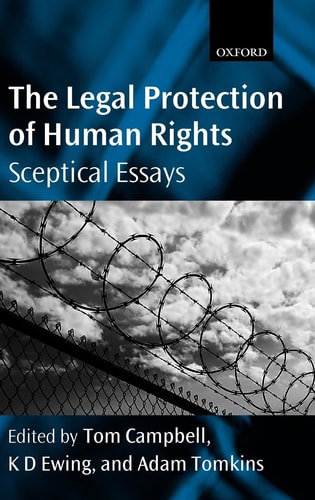
The Legal Protection of Human Rights: Sceptical Essays
0
0
As an Amazon Associate and affiliate partner, Menrva Books earns from qualifying purchases. Learn more
Author Description
Reacting to the mixed record of the UK Human Rights Act 1998 and similar enactments concerned with the protection of human rights, this book explores ways of promoting human rights more effectively through political and democratic mechanisms. The book expresses ideological skepticism concerning the relative neglect of social and economic rights and institutional skepticism concerning the limitations of court-centered means for enhancing human rights goals in general. The contributors criticize the 'juridification' of human rights through transferring the prime responsibility for identifying human rights violations to courts and advocate the greater 'politicization' of human rights responsibilities through such measures as enhanced parliamentary scrutiny of existing and proposed legislation. This group of twenty-four leading human rights scholars from around the world present a variety of perspectives on the disappointing human rights outcomes of recent institutional developments and consider the prospects of reviving the moral force and political implications of human rights values.Thus, contributors recount the failures of the Human Rights Act with regard to counter-terrorism; chart how the 'dialogue' model reduces parliaments' capacities to hold governments to account for human rights violations; consider which institutions best protect fundamental rights; and reflect on how the idea of human rights could be 'rescued' in Britain today. In addition, the book considers the historical human rights failures of courts during the Cold War and in Northern Ireland, the diverse outcomes of human rights judicial review, and aspects of the human rights regimes in a variety of jurisdictions, including Finland, Sweden, New Zealand, Australia, Scotland, Canada, Europe, and the United States.
Menrva's Summary
THE THESIS
This collection of essays investigates whether court-centered legal frameworks are the most effective mechanisms for protecting human rights or if democratic, political processes offer a superior alternative. The authors, a group of twenty-four distinguished legal scholars, challenge the trend of 'juridification'—the shifting of human rights oversight from parliaments to the judiciary. By analyzing the limitations of the UK Human Rights Act 1998 and similar international regimes, the contributors argue that current institutional reliance on judicial review often neglects social and economic rights while failing to hold governments accountable for systemic violations.
THE SCOPE MAP
What You Will Find
- Comparative analysis of human rights regimes in jurisdictions including Finland, Sweden, New Zealand, Australia, Scotland, Canada, and the United States.
- Critical evaluation of the 'dialogue' model of human rights and its impact on parliamentary oversight.
- Historical case studies examining judicial performance during the Cold War and the conflict in Northern Ireland.
- Theoretical arguments for the 'politicization' of human rights through enhanced legislative scrutiny and democratic engagement.
THE AUTHORITY PERSPECTIVE
Experts recognize this volume as a significant contribution to constitutional theory, particularly for its rigorous critique of judicial supremacy in human rights discourse. Readers frequently note the academic density of the prose, which makes it a foundational text for students and practitioners of public law and political philosophy.
Page Count:
552
Publication Date:
2011-05-15
Publisher:
Oxford University Press
ISBN-10:
0199606072
ISBN-13:
9780199606078
Non-Fiction
Human rights
Constitutional Law
Law
Community Tags
Similar Books