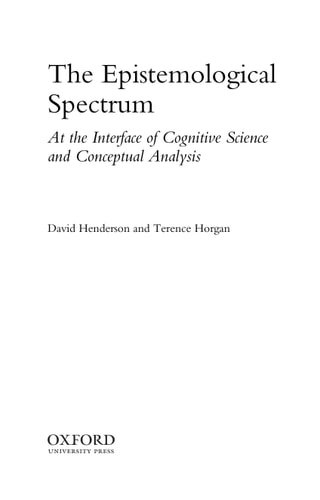
The Epistemological Spectrum: At the Interface of Cognitive Science and Conceptual Analysis
0
0
As an Amazon Associate and affiliate partner, Menrva Books earns from qualifying purchases. Learn more
Author Description
David Henderson and Terence Horgan set out a broad new approach to epistemology, which they see as a mixed discipline, having both a priori and empirical elements. They defend the roles of a priori reflection and conceptual analysis in philosophy, but their revisionary account of these philosophical methods allows them a subtle but essential empirical dimension. They espouse a dual-perspective position which they call iceberg epistemology, respecting the important differences between epistemic processes that are consciously accessible and those that are not. Reflecting on epistemic justification, they introduce the notion of transglobal reliability as the mark of the cognitive processes that are suitable for humans. Which cognitive processes these are depends on contingent facts about human cognitive capacities, and these cannot be known a priori.
Menrva's Summary
THE THESIS
How can epistemology effectively integrate a priori conceptual analysis with the empirical findings of cognitive science? The authors, Sir David K. Henderson and Terence Horgan, propose a revisionary framework that treats epistemology as a mixed discipline. By introducing the concept of iceberg epistemology, they argue that philosophical inquiry must account for both consciously accessible epistemic processes and those that operate beneath the surface of human awareness.
THE SCOPE MAP
What You Will Find
- A dual-perspective model of epistemology known as iceberg epistemology.
- An analysis of the role of a priori reflection in contemporary philosophical methodology.
- The introduction of transglobal reliability as a criterion for human cognitive processes.
- An examination of how contingent human cognitive capacities limit and define epistemic justification.
THE AUTHORITY PERSPECTIVE
Experts in the field recognize this work as a significant contribution to the naturalized epistemology debate. Readers frequently note the academic density of the prose, which requires a strong background in analytic philosophy to navigate effectively.
Page Count:
304
Publication Date:
2011-09-30
Publisher:
Oxford University Press
ISBN-10:
0199608547
ISBN-13:
9780199608546
Philosophy
Non-Fiction
Knowledge Theory
Epistemology
Community Tags
Similar Books