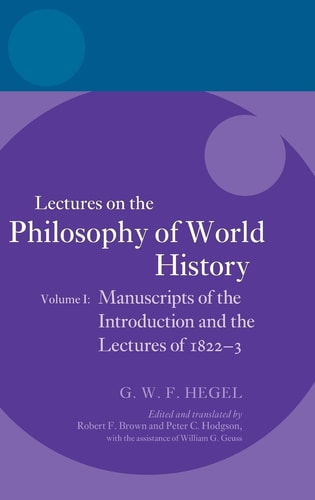
Hegel: Lectures on the Philosophy of World History, Volume I: Manuscripts of the Introduction and the Lectures of 1822-1823
0
0
As an Amazon Associate and affiliate partner, Menrva Books earns from qualifying purchases. Learn more
Author Description
This edition makes available an entirely new version of Hegel's lectures on the development and scope of world history. Volume I presents Hegel's surviving manuscripts of his introduction to the lectures and the full transcription of the first series of lectures (1822-23). These works treat the core of human history as the inexorable advance towards the establishment of a political state with just institutions-a state that consists of individuals with a free and fully-developed self-consciousness. Hegel interweaves major themes of spirit and culture-including social life, political systems, commerce, art and architecture, religion, and philosophy-with an historical account of peoples, dates, and events. Following spirit's quest for self-realization, the lectures presented here offer an imaginative voyage around the world, from the paternalistic, static realm of China to the cultural traditions of India; the vast but flawed political organization of the Persian Empire to Egypt and then the Orient; and the birth of freedom in the West to the Christian revelation of free political institutions emerging in the medieval and modern Germanic world.Brown and Hodgson's new translation is an essential resource for the English reader, and provides a fascinating account of the world as it was conceived by one of history's most influential philosophers. The Editorial Introduction surveys the history of the texts and provides an analytic summary of them, and editorial footnotes introduce readers to Hegel's many sources and allusions. For the first time an edition is made available that permits critical scholarly study, and translates to the needs of the general reader.
Menrva's Summary
THE THESIS
How does the progression of human history reflect the unfolding of spirit toward the realization of freedom and the establishment of the rational state? This volume, edited by Peter C. Hodgson and Robert F. Brown, compiles Hegel's manuscripts and lecture transcriptions from 1822-1823 to provide a comprehensive view of his philosophy of history. The editors utilize primary source manuscripts to reconstruct Hegel's lectures, arguing that history is not a random sequence of events but a teleological movement toward self-consciousness and political liberty. By examining the interplay between culture, religion, and political systems, the text establishes a framework for understanding the development of the modern state.
THE SCOPE MAP
What You Will Find
- Transcription of Hegel's 1822-1823 lecture series on world history.
- Analysis of the transition from Eastern civilizations to the Western political state.
- Editorial footnotes detailing Hegel's historical sources and philosophical allusions.
- A comprehensive editorial introduction surveying the history and significance of the manuscripts.
THE AUTHORITY PERSPECTIVE
Scholars and students of German Idealism regard this edition as a primary resource for accessing Hegel's mature thought on historical development. Readers frequently note the academic density of the prose, which requires careful engagement with Hegel's specific terminology and dialectical method.
Page Count:
464
Publication Date:
2011-06-04
Publisher:
Oxford University Press
ISBN-10:
0199601704
ISBN-13:
9780199601707
Philosophy
Non-Fiction
History
History
Community Tags
Other Editions(2)
Similar Books



Reader Comments
Share Your Thoughts
No comments yet. Be the first to share your thoughts!