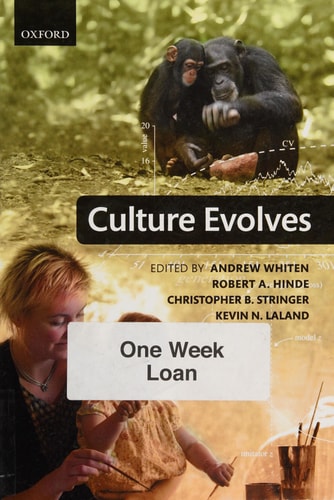
Culture Evolves
0
0
As an Amazon Associate and affiliate partner, Menrva Books earns from qualifying purchases. Learn more
Author Description
Culture - broadly defined as all we learn from others that endures for long enough to generate customs and traditions - shapes vast swathes of our lives and has allowed the human species to dominate the planet in an evolutionarily unique way. Culture and cultural evolution are uniquely significant phenomena in evolutionary biology: they are products of biological evolution, yet they supplement genetic transmission with social transmission, thus achieving a certain independence from natural selection. However, cultural evolution nevertheless expresses key Darwinian processes itself and also interacts with genetic evolution. Just how culture fits into the grander framework of evolution is a big issue though, yet one that has received relatively little scientific attention compared to, for example, genetic evolution. Our 'capacity for culture' appears so distinctive among animals that it is often thought to separate we cultural beings from the rest of nature and the Darwinian forces that shape it.'Culture Evolves' presents a different view arising from the recent discoveries of a diverse range of disciplines, that focus on evolutionary continuities. First, recent studies reveal that learning from others and the transmission of traditions are more widespread and significant across the animal kingdom than earlier recognized, helping us understand the evolutionary roots of culture. Second, archaeological discoveries have pushed back the origins of human culture to much more ancient times than traditionally thought. These developments together suggest important continuities between animal and human culture. A third new array of discoveries concerns the later diversification of human cultures, where the operations of Darwinian-like, cultural evolutionary processes are increasingly identified. Finally, surprising discoveries have been made about the imprint of cultural evolution in children's predisposition to acquire culture.The result of a major interdisciplinary meeting held by he Royal Society and the British Academy, this book presents the work of leading experts from the fields of ethology, behavioural ecology, primatology, comparative psychology, archaeology, anthropology, evolutionary biology and developmental psychology.
Menrva's Summary
THE THESIS
This volume investigates the mechanisms of cultural evolution and its complex, reciprocal relationship with biological evolution. The authors, a team of distinguished researchers in evolutionary biology and anthropology, synthesize recent findings to argue that culture is not a uniquely human phenomenon that separates us from nature, but rather a process with deep evolutionary roots. By examining evidence from animal behavior, archaeology, and developmental psychology, the text establishes a framework for understanding how cultural transmission functions alongside genetic inheritance.
THE SCOPE MAP
What You Will Find
- Comparative analysis of social learning and tradition transmission across diverse animal species.
- Archaeological evidence detailing the ancient origins and development of human cultural practices.
- Examination of Darwinian-like processes that drive the diversification of human cultures over time.
- Research into the biological predispositions in children that facilitate the acquisition of culture.
THE AUTHORITY PERSPECTIVE
Experts recognize this work as a significant interdisciplinary synthesis that bridges the gap between biological and cultural studies. Readers frequently note the academic density of the prose, which serves as a foundational resource for scholars and students interested in the evolutionary origins of human behavior.
Page Count:
480
Publication Date:
2012-03-02
Publisher:
Oxford University Press
ISBN-10:
0199608962
ISBN-13:
9780199608966
Psychology
Science
Evolutionary Biology
Anthropology
Archaeology
Psychology Comparative
Community Tags
Similar Books





Reader Comments
Share Your Thoughts
No comments yet. Be the first to share your thoughts!